

Start from basics and cover the entire length, breadth and depth of the IES/GATE and PSUs syllabus in an integrated manner and get guidance from experts.
LIVE Online Classes for IES,GATE and PSUs
ESE + GATE + PSUs
Live-online course. It is the most comprehensive and well-structured Course for ESE + GATE + PSUs.

ESE (Engineering Services Examination) and GATE (Graduate Aptitude Test in Engineering) are the most prestigious exams for engineering and science graduates in India. These exams offer numerous career options for aspirants to secure a promising career.
Students can get admission into postgraduate programs in prestigious colleges like IITs and for recruitment by numerous public sector undertakings (PSUs) or become an IES officer. The ESE & GATE exam evaluates a candidate's understanding of core subjects and technical knowledge.
Students preparing for the ESE & GATE exam together require a strategic approach, including understanding the exam pattern, and syllabus, and utilizing high-quality study materials. Second and third years candidates can also start their preparation with PW as we are providing dedicated batches for ESE + GATE 2026, and ESE + GATE 2027 for candidates’ early preparation.
What is ESE?
The ESE (Engineering Services Examination) is a prestigious national exam in India conducted by UPSC for recruitment to various technical posts in government departments. It is mainly for engineers in fields like civil, mechanical, electrical, and electronics. The exam is divided into three stages: Preliminary, Mains, and Interview. ESE qualifies candidates for roles like Indian Engineering Services (IES) officers, working in sectors like railways, defense, and public works.
What is GATE?
The GATE (Graduate Aptitude Test in Engineering) is a national-level exam in India for admission to postgraduate programs like M.Tech, M.S., and direct Ph.D. in engineering, technology, and architecture. It is also used by public sector companies for recruitment. The exam tests students' understanding of undergraduate-level subjects in engineering and science. GATE scores are highly regarded for further education and job opportunities in India and abroad.
Career Opportunities through GATE & ESE
The GATE (Graduate Aptitude Test in Engineering) and ESE (Engineering Services Examination) are among India’s most prestigious exams, offering lucrative career opportunities for engineering graduates. Through GATE, candidates can pursue higher education like M.Tech., M.E., or Ph.D. at top institutions like IITs, NITs, and IIITs, and even secure admission to international universities such as NTU and RWTH Aachen.
GATE scores are also a gateway to high-paying jobs in Public Sector Undertakings (PSUs) such as ONGC, BHEL, IOCL, and NTPC, where salaries often range from ₹10-15 LPA. Additionally, GATE-qualified candidates can explore research roles in organizations like DRDO, ISRO, and BARC, or opt for teaching positions in academia.
On the other hand, ESE, conducted by UPSC, recruits engineers for key government roles in services like the Indian Railways, Central Engineering Service (CES), and Indian Defence Service of Engineers (IDSE). These positions offer excellent job security, leadership roles, and perks such as housing, medical benefits, and pensions. While GATE focuses on research, PSUs, and technical roles, ESE provides broader career prospects in policymaking and infrastructure development. Both exams are ideal pathways to high-impact careers, catering to diverse aspirations of engineering professionals.
ESE Eligibility
Aspirants, before you dive into the preparation for the prestigious Engineering Services Examination (ESE 2026), make sure you meet the eligibility requirements. Here's a quick breakdown of what you need to qualify:
Who Can Apply?
- An Indian citizen or a subject of Nepal or Bhutan, or a Tibetan refugee who arrived in India before January 1, 1962, with the intention of permanent settlement
- A person of Indian origin who has migrated from Pakistan, Burma, Sri Lanka, or East African countries of Kenya, Uganda, the United Republic of Tanzania, Zambia, Malawi, Zaire, and Ethiopia, or Vietnam, intending to permanently settle in India.
- Provided that a candidate belongs to categories (except a citizen of India) mentioned above, shall be a person in whose favor a certificate of eligibility has been issued by the Government of India.
Age Limits: (As on 01/01/2026)
- Minimum Age: 21 years
- Maximum Age: 30 years
Age Relaxation for ESE exam is mentioned below:
| Category | Age Relaxation |
|---|---|
| SC/ST | +5 years |
| OBC (Non-Creamy Layer) | +3 years |
| PwBD (Persons with Benchmark Disabilities) | +10 years |
| Ex-Servicemen / Defence Personnel | Up to +5 years |
| Central Govt. Employees (Eligible Depts.) | Up to 35 years |
- A candidate for this examination must have attained the age of 21 years and must not have attained the age of 30 years on the 1st January, 2026 i.e., he/she must have been born not earlier than 2nd January, 1996 and not later than 1st January, 2005.
- The upper age-limit of 30 years will be relaxable upto 35 years in the case of Government servants of the following categories, if they are employed in a Department/ Office under the control of any of the authorities mentioned in column 1 below and apply for admission to the examination for all or any of the Service(s)/Post(s) mentioned in column 2, for which they are otherwise eligible.
- A candidate who holds substantively a permanent post in the particular Department/Office concerned. This relaxation will not be admissible to a probationer appointed against a permanent post in the Department/Office during the period of his probation. However, this relaxation will be admissible to a probationer so appointed provided he/she already retains a lien on a permanent post in a Department/Office under the control of any of the authorities mentioned in column 1 below.
- A candidate who has been continuously in a temporary service on a regular basis in the particular Department/Office for at least 3 years.
| Column 1 | Column 2 |
|---|---|
| Ministry of Railways (Railway Board) | IRMS (Civil) IRMS (Mechanical) IRMS (Electrical) IRMS (Signal &Telecommunication) IRMS(Stores) |
| Central Public Works Department | C.E.S. Group ‘A’, CE & MES Gr ‘A’ |
| Ministry of Road Transport and Highways | Central Engineering Service (Roads) Gr. ‘A’ |
| Ministry of Communication, Deptt. of Telecommunication | Indian Radio Regulatory Service Group ‘A’ Indian Telecommunication Service Group ‘A’,J.T.O. (G.C.S. Gr. ‘B’) |
| Ministry of Defence, Deptt. of Defence Production, Directorate General of Aeronautical Quality Assurance | Defence Aeronautical Quality Assurance Service(DAQAS) Gr ‘A’ |
| Ministry of Science and Technology, Deptt. of Science and Technology | Survey of India Gr ‘A’ Service |
| Ministry of MSME | Indian Enterprises Development Service |
| Border Roads Organisation | BRES Gr. ‘A’ |
| Indian Navy | Indian Naval Armament Service, Indian Naval Material Management Service |
| Military Engineer Services | Indian Defence Service of Engineers (lDSE) Group ‘A’ AEE(QS&C) in Military Engineer Service (MES) Surveyor Cadre |
| Ministry of Jal Shakti, Deptt. of Water Resources, River Development & Ganga Rejuvenation, Central Water Commission | Central Water Engineering Group-A Service. |
| Central Electricity Authority | CPES Gr ‘A’ |
| Geological Survey of India | Assistant Executive Engineer Gr ‘A’ |
| The Corps of Electronics and Mechanical Engineering, Ministry of Defence | AEE, Gr. ‘A’ (Mech. Engg. Posts) in the Corps of EME, Min. of Defence. AEE, Gr. ‘A’ (Electrical. Engg. Posts) in the Corps of EME, Min. of Defence. AEE, Gr. ‘A’(Electronics and Telecommunication Engs. Post) in the Corps of EME, Min. of Defence |
| Ministry of Skill Development & Entrepreneurship | Indian Skill Development Service |
| CATEGORY I—CIVIL ENGINEERING Group-A Services/Posts | CATEGORY II—MECHANICAL ENGINEERING Group-A/B Services/Posts | CATEGORY III—ELECTRICAL ENGINEERING Group-A/B Services/Posts | CATEGORY IV—ELECTRONICS AND TELECOMMUNICATION ENGINEERING Group-A/B Services/Posts |
|---|---|---|---|
| Central Engineering Service | AEE in GSI Engineering Service Gr ‘A’. | Central Electrical & Mechanical Engineering Service (Electrical Engineering Posts). | Indian Radio Regulatory Service Gr ‘A’ |
| Central Engineering Service (Roads), Group-A (Civil Engineering Posts). | Indian Naval Material Management Service (Mechanical Engineering Posts) | Indian Naval Material Management Service (Electrical Engineering Posts) | Indian Telecommunications Service Gr ‘A’. |
| Survey of India Group ‘A’ Service. | Defence Aeronautical Quality Assurance Service/SSO-II (Mechanical). | Central Power Engineering Service Gr ‘A’ (Electrical Engineering Posts). | Indian Naval Material Management Service (Electronics and Telecom Engineering Posts) |
| *AEE (Civil) in Border Roads Engineering Service | *AEE (Electrical and Mechanical) in Border Roads Engineering Service (Mechanical Engineering Posts). | Defence Aeronautical Quality Assurance Service/SSO-II (Electrical). | Defence Aeronautical Quality Assurance Service/SSO-II (Electronics & Tele). |
| AEE (QS&C) in MES Surveyor Cadre | Indian Skill Development Service. (vi) Indian Railway Management Services (Mechanical) | Indian Skill Development Service | Indian Skill Development Service |
| Central Water Engineering (Group ‘A’) Service. | Indian Railway Management Services (Stores) – Mechanical Engg. Posts. | Indian Enterprises Development Service/Assistant Director Grade-I (IEDS) Electrical Trade | Junior Telecom Officer Gr ‘B’ |
| Indian Skill Development Service. | Indian Enterprises Development Service/Assistant Director Grade-I (IEDS) Mechanical Trade | Indian Enterprises Development Service/Assistant Director Grade-II (IEDS) Electrical Trade | Indian Enterprises Development Service/Assistant Director Grade-I (IEDS) Electronics Trade |
| Indian Railway Management Service (Civil). | Indian Enterprises Development Service/Assistant Director Grade-II (IEDS) Mechanical Trade | Indian Railway Management Service (Electrical) | Indian Enterprises Development Service/Assistant Director Grade-II (IEDS) Electronics Trade |
| Indian Railway Management Service (Stores) – Civil Engg. Posts. | AEE Gr ‘A’(Mechanical Engineering Posts) in Corps of EME, Min of Defence | Indian Railway Management Service (Stores) – Electrical Engg. Posts. | Indian Railway Management Service (Signal &Telecommunication) |
| AEE Gr ‘A’(Electrical Engineering Posts) in Corps of EME, Min of Defence | Indian Railway Management Service (Stores) – S & T Engg. Posts. | ||
| AEE Gr ‘A’(Electronics & Telecommunication Engineering Posts) in Corps of EME, Min of Defence |
The upper age-limit prescribed above will be further relaxable:
- Up to a maximum of five years if a candidate belongs to a scheduled caste or a scheduled tribe.
- Up to a maximum of three years in case if candidate belongs to the OBC category.
- Upto a maximum of three years in case of defence service personnel disabled in operations during hostilities with any foreign country or in a disturbed area, and released as a consequence thereof.
- Upto a maximum of five years in case of ex-servicemen including Commissioned Officers and ECOs/SSCOs who have rendered at least five years Military Service as on 1st January 2026, and have been released
- On completion of assignment (including those whose assignment is due) to be completed within one year from 1st January 2026) otherwise than by way of dismissal or discharge on account of misconduct or inefficiency, or
- On account of physical disability attributable to Military Service or
- On invalidment.
- Upto a maximum of five years in the case of ECOs/SSCOs who have completed an initial period of assignment of five years of Military Services as on 1st January 2025, and whose assignment has been extended beyond five years and in whose case the Ministry of Defence issues a certificate that they can apply for civil employment and they will be released on three months notice on selection from the date of receipt of offer of appointment.
- Up to a maximum of 10 years in the case of candidates of PwBD (Low vision Locomotor Disability including Cerebral Palsy, Leprosy cured, Dwarfism, Acid Attack victims & Muscular Dystrophy and Hard of Hearing).
- A candidate of ESE-2026 will be eligible to get benefit of economically weaker Section reservation only in case the candidate meets the criteria issued by the Central Government and is in possession of requisite Income & Asset Certificate based on income of financial year 2024-2025 and issued on/after 01.04.2025 (after the completion of FY 2024-25) but not later than the closing date of the application for Engineering Services (Preliminary) Examination-2026 i.e. 16 Oct, 2025.
- The OBC candidates applying for ESE- 2026 must produce OBC (Non-Creamy Layer) certificate based on the Income for the Financial Year (FY) 2024-25, 2023-2024, 2022-2023 and issued on/after 01.04.2025 (after the completion of FY 2024-25) but not later than the closing date of the application for Engineering Services (Preliminary) Examination-2026 i.e 16 Oct, 2025.
Minimum Educational Qualifications:
- An Engineering degree from a university set up by an Act of the Central or State Legislature in India, or from an institution recognized under the UGC Act, 1956 or
- Passed both Section A and B of the Institution of Engineers (India) exam or
- An Engineering degree or diploma from a foreign university/institution, recognized by the Government of India or
- Passed the Graduate Membership Exam of the Institute of Electronics and Telecommunication Engineers (India) or
- Passed Associate Membership Exams Parts II and III / Sections A and B of the Aeronautical Society of India or
- Passed the Graduate Membership Exam of the Institution of Electronics and Radio Engineers, London, held after November 1959.
Additional qualifications (specific to certain posts):
- For Indian Naval Armament Service (Electronics Engineering Posts): M.Sc. (or equivalent) in Wireless Communication Electronics, Radio Physics, or Radio Engineering.
- For Indian Radio Regulatory Service: M.Sc. (or equivalent) in Wireless Communication Electronics, Radio Physics, Radio Engineering, or a Master’s in Science with Physics and Radio Communication, Electronics, or Telecommunication as a special subject.
ESE Exam Pattern
UPSC conducts the ESE exam in three phases, that is, prelims, mains, and a personality test or interview. In each phase, candidates are tested on a different scale. Let us know about this exam pattern in detail.
Stage-I: Preliminary Examination (Objective Type)
| STAGE-I | PAPER TYPE | DURATION | MARKS |
|---|---|---|---|
| PAPER-I | GENERAL STUDIES AND ENGINEERING APTITUDE | 02 HOURS | 200 |
| PAPER-II | ENGINEERING DISCIPLINE (CE/ ME/ EE/ E&T) | 03 HOURS | 300 |
| TOTAL MARKS | 500 | ||
- Note: Minimum Qualifying Marks for each Paper will be at the discretion of the commission.
- Only those candidates qualifying at this Stage are permitted to appear for Stage – II examination.
Stage-II: Main Examination (Descriptive Type)
| STAGE-II | PAPER TYPE | DURATION | MARKS |
|---|---|---|---|
| PAPER-I | ENGINEERING DISCIPLINE (CE/ ME/ EE/ E&T) | 03 HOURS | 300 |
| PAPER-II | ENGINEERING DISCIPLINE (CE/ ME/ EE/ E&T) | 03 HOURS | 300 |
| TOTAL MARKS (MAIN) | 600 | ||
| TOTAL MARKS (MAINS + PRELIM) | 1100 | ||
- Only those candidates qualifying at this stage (i.e. Stage – I + Stage – II) are selected for Stage – III which is the Personality Test (Interview).
Stage-III: Personality Test (Interview)
| STAGE-III | MARKS |
|---|---|
| Personality Test | 200 |
| STAGE-I+ STAGE-II+STAGE III | 1300 |
- The Candidates who have qualified all stages (Stage I + Stage II + Stage III) ,will be included in the final list of ESE(Engineering Services Exam).
ESE Exam Syllabus
Stage I - Paper I, Objective type, Common to all Candidates, duration 2 hours, Maximum Marks 200.
- Current issues of national and international importance relating to social, economic and industrial development
- Engineering Aptitude covering Logical reasoning and Analytical ability
- Engineering Mathematics and Numerical Analysis
- General Principles of Design, Drawing, Importance of Safety
- Standards and Quality practices in production, construction, maintenance and services
- Basics of Energy and Environment : Conservation, Environmental pollution and degradation, Climate change, Environmental impact assessment
- Basics of Project Management
- Basics of Material Science and Engineering
- Information and Communication Technologies (ICT) based tools and their applications in Engineering such as networking, e-governance and technology based education.
- Ethics and values in engineering profession
Note: The paper in General Studies and Engineering Aptitude will include the knowledge of relevant topics as may be expected from an engineering graduate, without special study. Questions from all the 10 topics mentioned above shall be set. Marks for each topic may range from 5% to 15% of the total marks on the paper.

SYLLABI OF FOUR ENGINEERING DISCIPLINES
Mechanical Engineering
(Contents for syllabi of both the Papers together for Stage-I objective type Paper–II and separately for Stage-II Conventional type Paper-I and Paper – II)
PAPER – I
1. Fluid Mechanics:
Basic Concepts and Properties of Fluids, Manometry, Fluid Statics, Buoyancy, Equations of Motion, Bernoulli’s equation and applications, Viscous flow of incompressible fluids, Laminar and Turbulent flows, Flow through pipes and head losses in pipes.
2. Thermodynamics and Heat transfer:
Thermodynamic systems and processes; properties of pure substance; Zeroth, First and Second Laws of Thermodynamics; Entropy, Irreversibility and availability; analysis of thermodynamic cycles related to energy conversion: Rankine, Otto, Diesel and Dual Cycles; ideal and real gases; compressibility factor; Gas mixtures. Modes of heat transfer, Steady and unsteady heat conduction, Thermal resistance, Fins, Free and forced convection, Correlations for convective heat transfer, Radiative heat transfer – Radiation heat transfer co-efficient; boiling and condensation, Heat exchanger performance analysis.
3. IC Engines, Refrigeration and Air conditioning:
SI and CI Engines, Engine Systems and Components, Performance characteristics and testing of IC Engines; Fuels; Emissions and Emission Control. Vapour compression refrigeration, Refrigerants and Working cycles, Compressors, Condensers, Evaporators and Expansion devices, Other types of refrigeration systems like Vapour Absorption, Vapour jet, thermo electric and Vortex tube refrigeration. Psychometric properties and processes, Comfort chart, Comfort and industrial air conditioning, Load calculations and Heat pumps.
4. Turbo Machinery:
Reciprocating and Rotary pumps, Pelton wheel, Kaplan and Francis Turbines, velocity diagrams, Impulse and Reaction principles, Steam and Gas Turbines, Theory of Jet Propulsion – Pulse jet and RamJet Engines, Reciprocating and Rotary Compressors – Theory and Applications
5. Power Plant Engineering:
Rankine and Brayton cycles with regeneration and reheat, Fuels and their properties, Flue gas analysis, Boilers, steam turbines and other power plant components like condensers, air ejectors, electrostatic precipitators and cooling towers – their theory and design, types and applications;
6. Renewable Sources of Energy:
Solar Radiation, Solar Thermal Energy collection - Flat Plate and focusing collectors their materials and performance. Solar Thermal Energy Storage, Applications – heating, cooling and Power Generation; Solar Photovoltaic Conversion; Harnessing of Wind Energy, Bio-mass and Tidal Energy – Methods and Applications, Working principles of Fuel Cells.
PAPER – II
7. Engineering Mechanics:
Analysis of System of Forces, Friction, Centroid and Centre of Gravity, Dynamics; Stresses and Strains-Compound Stresses and Strains, Bending Moment and Shear Force Diagrams, Theory of Bending Stresses- Slope and deflection-Torsion, Thin and thick Cylinders, Spheres.
8. Engineering Materials:
Basic Crystallography, Alloys and Phase diagrams, Heat Treatment, Ferrous and Non Ferrous Metals, Non metallic materials, Basics of Nano-materials, Mechanical Properties and Testing, Corrosion prevention and control
9. Mechanisms and Machines:
Types of Kinematics Pair, Mobility, Inversions, Kinematic Analysis, Velocity and Acceleration Analysis of Planar Mechanisms, CAMs with uniform acceleration and retardation, cycloidal motion, oscillating followers; Vibrations –Free and forced vibration of undamped and damped SDOF systems, Transmissibility Ratio, Vibration Isolation, Critical Speed of Shafts. Gears – Geometry of tooth profiles, Law of gearing, Involute profile, Interference, Helical, Spiral and Worm Gears, Gear Trains- Simple, compound and Epicyclic; Dynamic Analysis – Slider – crank mechanisms, turning moment computations, balancing of Revolving & Reciprocating masses, Gyroscopes –Effect of Gyroscopic couple on automobiles, ships and aircrafts, Governors.
10. Design of Machine Elements:
Design for static and dynamic loading; failure theories; fatigue strength and the S-N diagram; principles of the design of machine elements such as riveted, welded and bolted joints. Shafts, Spur gears, rolling and sliding contact bearings, Brakes and clutches, flywheels.
11. Manufacturing ,Industrial and Maintenance Engineering:
Metal casting-Metal forming, Metal Joining, Machining and machine tool operations, Limits, fits and tolerances, Metrology and inspection, computer Integrated manufacturing, FMS, Production planning and Control, Inventory control and operations research - CPM-PERT. Failure concepts and characteristics-Reliability, Failure analysis, Machine Vibration, Data acquisition, Fault Detection, Vibration Monitoring, Field Balancing of Rotors, Noise Monitoring, Wear and Debris Analysis, Signature Analysis, NDT Techniques in Condition Monitoring.
12. Mechatronics and Robotics:
Microprocessors and Microcontrollers: Architecture, programming, I/O, Computer interfacing, Programmable logic controller. Sensors and actuators, Piezoelectric accelerometer, Hall effect sensor, Optical Encoder, Resolver, Inductosyn, Pneumatic and Hydraulic actuators, stepper motor, Control Systems- Mathematical modeling of Physical systems, control signals, controllability and observability. Robotics, Robot Classification, Robot Specification, notation; Direct and Inverse Kinematics; Homogeneous Coordinates and Arm Equation of four Axis SCARA Robot.
Electrical Engineering
(Contents for syllabi of both the Papers together for Stage-I objective type Paper–II and separately for Stage-II Conventional type Paper-I and Paper – II)
PAPER – I
1. Engineering Mathematics:
Matrix theory, Eigen values & Eigen vectors, system of linear equations, Numerical methods for solution of non-linear algebraic equations and differential equations, integral calculus, partial derivatives, maxima and minima, Line, Surface and Volume Integrals. Fourier series, linear, non-linear and partial differential equations, initial and boundary value problems, complex variables, Taylor’s and Laurent’s series, residue theorem, probability and statistics fundamentals, Sampling theorem, random variables, Normal and Poisson distributions, correlation and regression analysis.
2. Electrical Materials:
Electrical Engineering Materials, crystal structures and defects, ceramic materials, insulating materials, magnetic materials – basics, properties and applications; ferrities, ferro-magnetic materials and components; basics of solid state physics, conductors; Photo-conductivity; Basics of Nano materials and Superconductors.
3. Electric Circuits and Fields:
Circuit elements, network graph, KCL, KVL, Node and Mesh analysis, ideal current and voltage sources, Thevenin’s, Norton’s, Superposition and Maximum Power Transfer theorems, transient response of DC and AC networks, Sinusoidal steady state analysis, basic filter concepts, two-port networks, three phase circuits, Magnetically coupled circuits, Gauss Theorem, electric field and potential due to point, line, plane and spherical charge distributions, Ampere’s and Biot-Savart’s laws; inductance, dielectrics, capacitance; Maxwell’s equations.
4. Electrical and Electronic Measurements:
Principles of measurement, accuracy, precision and standards; Bridges and potentiometers; moving coil, moving iron, dynamometer and induction type instruments, measurement of voltage, current, power, energy and power factor, instrument transformers, digital voltmeters and multimeters, phase, time and frequency measurement, Q-meters, oscilloscopes, potentiometric recorders, error analysis, Basics of sensors, Transducers, basics of data acquisition systems
5. Computer Fundamentals:
Number systems, Boolean algebra, arithmetic functions, Basic Architecture, Central Processing Unit, I/O and Memory Organisation; peripheral devices, data representation and programming, basics of Operating system and networking, virtual memory, file systems; Elements of programming languages, typical examples.
6. Basic Electronics Engineering:
Basics of Semiconductor diodes and transistors and characteristics, Junction and field effect transistors (BJT, FET and MOSFETS), different types of transistor amplifiers, equivalent circuits and frequency response; oscillators and other circuits, feedback amplifiers.
PAPER – II
1. Analog and Digital Electronics:
Operational amplifiers – characteristics and applications, combinational and sequential logic circuits, multiplexers, multi-vibrators, sample and hold circuits, A/D and D/A converters, basics of filter circuits and applications, simple active filters; Microprocessor basics- interfaces and applications, basics of linear integrated circuits; Analog communication basics, Modulation and demodulation, noise and bandwidth, transmitters and receivers, signal to noise ratio, digital communication basics, sampling, quantizing, coding, frequency and time domain multiplexing, power line carrier communication systems.
2. Systems and Signal Processing :
Representation of continuous and discrete-time signals, shifting and scaling operations, linear, time-invariant and causal systems, Fourier series representation of continuous periodic signals, sampling theorem, Fourier and Laplace transforms, Z transforms, Discrete Fourier transform, FFT, linear convolution, discrete cosine transform, FIR filter, IIR filter, bilinear transformation.
3. Control Systems:
Principles of feedback, transfer function, block diagrams and signal flow graphs, steady-state errors, transforms and their applications; Routh-hurwitz criterion, Nyquist techniques, Bode plots, root loci, lag, lead and lead-lag compensation, stability analysis, transient and frequency response analysis, state space model, state transition matrix, controllability and observability, linear state variable feedback, PID and industrial controllers.
4. Electrical Machines :
Single phase transformers, three phase transformers - connections, parallel operation, auto-transformer, energy conversion principles, DC machines - types, windings, generator characteristics, armature reaction and commutation, starting and speed control of motors, Induction motors - principles, types, performance characteristics, starting and speed control, Synchronous machines - performance, regulation, parallel operation of generators, motor starting, characteristics and applications, servo and stepper motors.
5. Power Systems :
Basic power generation concepts, steam, gas and water turbines, transmission line models and performance, cable performance, insulation, corona and radio interference, power factor correction, symmetrical components, fault analysis, principles of protection systems, basics of solid state relays and digital protection; Circuit breakers, Radial and ring-main distribution systems, Matrix representation of power systems, load flow analysis, voltage control and economic operation, System stability concepts, Swing curves and equal area criterion. HVDC transmission and FACTS concepts, Concepts of power system dynamics, distributed generation, solar and wind power, smart grid concepts, environmental implications, fundamentals of power economics.
6. Power Electronics and Drives :
Semiconductor power diodes, transistors, thyristors, triacs, GTOs, MOSFETs and IGBTs - static characteristics and principles of operation, triggering circuits, phase control rectifiers, bridge converters - fully controlled and half controlled, principles of choppers and inverters, basis concepts of adjustable speed dc and ac drives, DC-DC switched mode converters, DC-AC switched mode converters, resonant converters, high frequency inductors and transformers, power supplies.
Electronics & Telecommunication Engineering
(Contents for syllabi of both the Papers together for Stage-I objective type Paper–II and separately for Stage-II Conventional type Paper-I and Paper – II)
PAPER – I
1. Basic Electronics Engineering:
Basics of semiconductors; Diode/Transistor basics and characteristics; Diodes for different uses; Junction & Field Effect Transistors (BJTs, JFETs, MOSFETs); Transistor amplifiers of different types, oscillators and other circuits; Basics of Integrated Circuits (ICs); Bipolar, MOS and CMOS ICs; Basics of linear ICs, operational amplifiers and their applications-linear/non-linear; Optical sources/detectors; Basics of Opto electronics and its applications.
2. Basic Electrical Engineering:
DC circuits-Ohm’s & Kirchoff’s laws, mesh and nodal analysis, circuit theorems; Electro-magnetism, Faraday’s & Lenz’s laws, induced EMF and its uses; Single-phase AC circuits; Transformers, efficiency; Basics-DC machines, induction machines, and synchronous machines; Electrical power sources- basics: hydroelectric, thermal, nuclear, wind, solar; Basics of batteries and their uses.
3. Materials Science:
Electrical Engineering materials; Crystal structure & defects; Ceramic materials-structures, composites, processing and uses; Insulating laminates for electronics, structures, properties and uses; Magnetic materials, basics, classification, ferrites, ferro/para-magnetic materials and components; Nano materials-basics, preparation, purification, sintering, nanoparticles and uses; Nano-optical/magnetic/electronic materials and uses; Superconductivity, uses.
4. Electronic Measurements and Instrumentation:
Principles of measurement, accuracy, precision and standards; Analog and Digital systems for measurement, measuring instruments for different applications; Static/dynamic characteristics of measurement systems, errors, statistical analysis and curve fitting; Measurement systems for non-electrical quantities; Basics of telemetry; Different types of transducers and displays; Data acquisition system basics.
5. Network Theory:
Network graphs & matrices; Wye-Delta transformation; Linear constant coefficient differential equations- time domain analysis of RLC circuits; Solution of network equations using Laplace transforms- frequency domain analysis of RLC circuits; 2-port network parameters-driving point & transfer functions; State equations for networks; Steady state sinusoidal analysis.
6. Analog and Digital Circuits:
Small signal equivalent circuits of diodes, BJTS and FETs; Diode circuits for different uses; Biasing & stability of BJT & JFET amplifier circuits; Analysis/design of amplifier- single/multi-stage; Feedback & uses; Active filters, timers, multipliers, wave shaping, A/D-D/A converters; Boolean Algebra uses; Logic gates, Digital IC families, Combinatorial/sequential circuits; Basics of multiplexers, counters/registers/ memories /microprocessors, design & applications.
PAPER – II
1. Analog and Digital Communication Systems:
Random signals, noise, probability theory, information theory; Analog versus digital communication & applications: Systems- AM, FM, transmitters/receivers, theory/practice/ standards, SNR comparison; Digital communication basics: Sampling, quantizing, coding, PCM, DPCM, multiplexing-audio/video; Digital modulation: ASK, FSK, PSK; Multiple access: TDMA, FDMA, CDMA; Optical communication: fibre optics, theory, practice/standards.
2. Control Systems:
Classification of signals and systems; Application of signal and system theory; System realization; Transforms& their applications; Signal flow graphs, Routh-Hurwitz criteria, root loci, Nyquist/Bode plots; Feedback systems-open & closed loop types, stability analysis, steady state, transient and frequency response analysis; Design of control systems, compensators, elements of lead/lag compensation, PID and industrial controllers.
3. Computer Organization and Architecture:
Basic architecture, CPU, I/O organisation, memory organisation, peripheral devices, trends; Hardware /software issues; Data representation & Programming; Operating systems-basics, processes, characteristics, applications; Memory management, virtual memory, file systems, protection & security; Databases, different types, characteristics and design; Transactions and concurrency control; Elements of programming languages, typical examples.
4. Electro Magnetics:
Elements of vector calculus, Maxwell’s equations-basic concepts; Gauss’, Stokes’ theorems; Wave propagation through different media; Transmission Lines-different types, basics, Smith’s chart, impedance matching/transformation, S-parameters, pulse excitation, uses; Waveguides-basics, rectangular types, modes, cut-off frequency, dispersion, dielectric types; Antennas-radiation pattern, monopoles/dipoles, gain, arrays-active/passive, theory, uses.
5. Advanced Electronics Topics:
VLSI technology: Processing, lithography, interconnects, packaging, testing; VLSI design: Principles, MUX/ROM/PLA-based design, Moore & Mealy circuit design; Pipeline concepts & functions; Design for testability, examples; DSP: Discrete time signals/systems, uses; Digital filters: FIR/IIR types, design, speech/audio/radar signal processing uses; Microprocessors & microcontrollers, basics, interrupts, DMA, instruction sets, interfacing; Controllers & uses; Embedded systems.
6. Advanced Communication Topics:
Communication networks: Principles /practices /technologies /uses /OSI model/security; Basic packet multiplexed streams/scheduling; Cellular networks, types, analysis, protocols (TCP/TCPIP); Microwave & satellite communication: Terrestrial/space type LOS systems, block schematics link calculations, system design; Communication satellites, orbits, characteristics, systems, uses; Fibre-optic communication systems, block schematics, link calculations, system design.
GATE EXAM 2026 : What’s New?
- Two new subjects –There are now two new subjects: Geomatics Engineering (GE) and Naval Architecture and Marine Engineering (NM). Thus, the total number of subjects has increased to 30.
- In another newly introduced change, students applying for the GATE Exam 2026 can also opt for two different papers from the prescribed set of combinations.
- The eligibility criteria to appear for GATE-2026 have been relaxed from a minimum 10+2+4 (ongoing) to a minimum 10+2+3 (ongoing), enabling even those in the third year of their undergraduate studies to appear for the examination. Thus, candidates have an additional opportunity to improve their performance and secure better career options.
- All test papers of the GATE Exam 2026 will be entirely objective type. The pattern of questions may include (i) Multiple Choice Questions (MCQ), (ii) Multiple Select Questions (MSQ), and/or (iii) Numerical Answer Type (NAT) questions.
Combination of Two Papers Allowed
(Subject to availability of infrastructure and schedule)
| Code of The First (Primary) Paper | Codes of Papers Allowed as The Second Paper |
|---|---|
| AE | CE, ME, XE |
| AG | CE |
| AR | CE, GE |
| BM | BT, IN |
| BT | BM, XL |
| CE | AE, AG, AR, ES, GE, NM, XE |
| CH | ES, PE , XE |
| CS | DA, EC, GE, MA, PH, ST |
| CY | XE, XL |
| EC | CS, DA, IN, PH, EE |
| EE | DA, EC, IN, PH |
| ES | CE, CH, GE |
| EY | XL |
| GE | AR, CE, GG, ES, CS |
| GG | GE |
| IN | BM, EC, EE, ME |
| MA | CS, DA, PH, ST |
| ME | AE, DA, IN, NM, PI, XE |
| MN | - |
| MT | XE |
| NM | CE, ME |
| PE | CH |
| PH | CS, DA, EC, EE, MA, XE |
| PI | ME, XE |
| ST | CS, DA, MA, XH |
| DA | CS, EC, EE, MA, ME, PH, ST, XE |
| XE | AE, CE, CH, CY, DA, ME, MT, PH. PI |
| XH | ST |
| XL | AE, CE, CH, CY, DA, ME, MT, PH. PI |
| TF | - |
GATE Exam Organizing Institutes
The GATE exam is organized annually by the top institutes in India, including IIT Bombay, IIT Delhi, IIT Guwahati, IIT Kanpur, IIT Kharagpur, IIT Madras, IIT Roorkee, and IISc Bangalore. These institutes take turns hosting the exam on a rotational basis. The table below shows which institute organized the exam in different years. IIT Guwahati is scheduled to host the GATE 2026 examination.
Here is the list of institutes that have conducted the GATE exam from 1995 to 2026:
| Year | Organizing Institute |
|---|---|
| 2026 | IIT Guwahati |
| 2025 | IIT Roorkee |
| 2024 | IISC Bengaluru |
| 2023 | IIT Kanpur |
| 2022 | IIT Kharagpur |
| 2021 | IIT Bombay |
| 2020 | IIT Delhi |
| 2019 | IIT Madras |
| 2018 | IIT Guwahati |
| 2017 | IIT Roorkee |
| 2016 | IISc Bangalore |
| 2015 | IIT Kanpur |
| 2014 | IIT Kharagpur |
| 2013 | IIT Bombay |
| 2012 | IIT Delhi |
| 2011 | IIT Madras |
| 2010 | IIT Guwahati |
| 2009 | IIT Roorkee |
| 2008 | IISc Bangalore |
| 2007 | IIT Kanpur |
| 2006 | IIT Kharagpur |
| 2005 | IIT Bombay |
| 2004 | IIT Delhi |
| 2003 | IIT Madras |
| 2002 | IISc Banglore |
| 2001 | IIT Kanpur |
| 2000 | IIT Kharagpur |
| 1999 | IIT Bombay |
| 1998 | IIT Delhi |
| 1997 | IIT Madras |
| 1996 | IISc Banglore |
| 1995 | IIT Kanpur |
GATE Paper Codes
Moving on, let us see that, while filling out the GATE application form, candidates have to keep in mind the subject paper code. As per the GATE 2025 Information Brochure, candidates can choose a maximum of two subject papers from the list of 30 available options. It is recommended that candidates choose the papers related to their qualifying degree. However, candidates are free to choose any subject paper as per their future admission goals; just make sure to check the eligibility criteria of the institutes where you are planning to apply. The subject codes are mentioned below:
| PAPER | CODE |
|---|---|
| Aerospace Engineering | AE |
| Agricultural Engineering | AG |
| Architecture and Planning | AR |
| Biotechnology | BT |
| Bio - medical Engineering | BM |
| Civil Engineering | CE |
| Chemical Engineering | CH |
| Computer Science & Information Technology | CS |
| Chemistry | CY |
| Electronics and Communication Engineering | EC |
| Electrical Engineering | EE |
| Engineering Sciences | XE |
| Petroleum Engineering | PE |
| Geomatics Engineering | GE |
| Geology and Geophysics | GG |
| Instrumentation Engineering | IN |
| Life Sciences | XL |
| Mathematics | MA |
| Mechanical Engineering | ME |
| Mining Engineering | MN |
| Metallurgical Engineering | MT |
| Naval Architecture & Marine Engineering | NM |
| Physics | PH |
| Production and Industrial Engineering | PI |
| Textile Engineering & Fibre Science | TF |
| Ecology and Evolution | EY |
| Statistics | ST |
| Environmental Science and Engineering | ES |
| Humanities and Social Sciences | XH |
| Data Science & Artificial Intelligence | DA |
With a successful attempt in GATE an aspirant can choose the most suitable option from wide range of roads to travel to his final career destination :
- Students can pursue M.Tech/M.S/ M.E/Ph.D from IISc Bangalore, IITs, NITs, IIITs and other reputed institutes.
- Students can pursue Post Graduate Diploma in Industrial Engineering (PGDIE), Post Graduate Diploma in Manufacturing Management (PGDMM), Post Graduate Diploma in Project Management (PGDPM) from NITIE Mumbai.
- Several reputed Maharatna and Navratna PSUs and research organizations recruit on basis of GATE Score. i.e. IOCL, NTPC, BHEL, PGCIL, BARC, CSIR etc.
- Teaching: Professor, Asst. Professor at IITs, NITs and other reputed educational institutes.
- Junior Research Fellow: ISRO, DRDO, BARC, CSIR, IITs etc.
- Senior Research Fellow: ISRO, DRDO, BARC, CSIR, IITs etc.
- Junior/Senior Research Associates.
- Scientists “C” grade jobs.
- Lucrative opportunities in research & development after post-graduation.
- Multinational firms shortlist candidates on the basis of GATE score.
- Some international universities offers M.S or Ph.D programs on the basis of GATE Score.
GATE Exam Eligibility Criteria
Anyone who has successfully completed 10+2+2 or 10+3+1 and currently studying in 3rd or higher years of any undergraduate degree program OR has already graduated in any government approved degree program in Engineering / Technology / Architecture / Science / Commerce / Arts is eligible to apply for GATE.
| Qualifying Degree | Qualifying Degree/Examination | Description of eligible candidates |
|---|---|---|
| BE/BTech/BPharm | Bachelor’s degree holders in Engineering/Technology (4 years after 10+2 or 3 years after B.Sc./Diploma in Engineering /Technology) | Currently in the 3rd year or higher or already completed |
| B.Arch | Bachelor’s degree holders of Architecture (5 years course) | Currently in the 3rd year or higher or already completed |
| B.Sc (Research)/BS | Bachelor’s degree in Science (Post-Diploma/4 years after 10+2) | Currently in the 3rd year or higher or already completed |
| MSc/MA/MCA or equivalent | Master’s degree in any branch of Science/Arts/Mathematics/Statistics/Computer Applications or equivalent | Currently in the first year or higher or already completed |
| Int ME/ M.Tech (Post-B.Sc) | Post-B.Sc Integrated Master’s degree programs in Engineering/Technology (4 year program) | Currently in the 1st/ 2nd/ 3rd/4th year or already completed |
| Int ME/ M.Tech or Dual Degree (after Diploma or 10+2) | Integrated Master’s degree program or Dual Degree program in Engineering/Technology (5 year program) | Currently in the 3rd/ 4th/5th year or already completed |
| Int M.Sc/ Int BS-MS | Integrated M.Sc. or 5 years integrated B.S.-M.S. program | Currently in the 3rd year or higher or already completed |
| Professional Society Examinations (equivalent to BE/BTech/BArch) | B.E./B.Tech./B.Arch. equivalent examinations of Professional Societies, recognised by MoE/UPSC/AICTE (e.g., AMIE by Institution of Engineers-India, AMICE by the Institute of Civil Engineers-India and so on) | Completed Section A or equivalent of such professional courses |
GATE Exam Preparation Strategy
Big Journeys begin with Small Steps
"Success doesn’t necessarily come from breakthrough Innovation, but from flawless Execution."
Often I hear a concern among the students regarding “What should be our strategy to crack GATE exams? To answer this question in the most simplified way, this article is my sincere effort to strategise things for aspirants, which will be fruitful for young friends.
There are two categories of ESE/GATE Aspirants : (1) Freshers , preparing first time for the competitive exams (Neophytes) (2) Repeaters , who have already given one or more attempts (Rank Improvers)
(I) Strategy for Neophytes:
If you are a fresher and preparing first time then I would suggest you the following approach to be adopted-
- Define your aim and target the desired exam right from the beginning. You should examine closely the examination pattern, syllabus and the level of difficulty.
- The first step for amateurs should be, to go through previous years’ question papers of the aimed exam and identify what type of questions are asked, like whether it is theoretical (then what subjects/which topics are mostly asked) or derivations or numerical type.
- Keep one best reference book for each subject. You are not advised to read too many books for each subject; practically it is not possible in limited time frame.
The STUDY REGIME:
Make an overall plan of your career; define immediate and ultimate goals of your career, then make a roadmap to execute in most effective manner. Being an engineer you should understand the importance of planning and execution of the plan.
Overall plan may be further divided in three stages:
1. Six month /One year plan:
Divide months for different subjects and plan it so as to complete the entire syllabus in the left over time. In the current scenario of high cut-offs, do not go for selective study; instead cover the entire syllabus, because you never know “the topic left could be the topic of conquest.”
2. Subject-wise Plan/ Bi-weekly plan:
For each subject, study should be exam oriented, i.e. you should get acclimatize with the subject , so that you may know which area is to be focussed like whether theory has to be focussed or numerical or solving previous years’ questions will suffice. Every subject requires different approach. For example in mathematics you may be required to focus on practicing problems where as in English altogether different approach, similarly in technical subjects the approach may differ from subject to subject.
If you are enrolled in any coaching institute, then concentrate and study well in coaching classroom, your class notes should be full and final and should be ready in classroom itself, with simultaneous marking of IMPORTANT concept /formulae and develop a habit of writing of NOTE points ,wherever required. If only self study is your style of preparing without coaching, then also notes making is advisable.
One point to be kept in mind is “Work for Yourself”; i.e. make notes for yourself, it should be self hand written notes, as this will develop your writing efficiency in terms of speed, accuracy hand writing and also helps in memory retention.
3. Daily To-Do list /Daily plan:
This is basically for effective time management. Plan and freeze the study hours and abstain from using mobile phones, social media, what's app etc during these hours. 10 to 15 minutes are sufficient to plan next day schedule, it will help in removing redundant activities of your schedule and you can make best use of your time for study. I would also suggest you to pre plan your area /subject /topic of your study for the next day, it would help in activating senses of your mind to stimulate for study which helps in better memory retention.
Solving previous years’ questions of GATE (at least of last 10-15 years) should be made contemporaneous with class notes. Do not postpone it for later, topic that is covered in class or studied on your own, finish the previous years' questions on priority basis.
While solving questions, mark the questions which you were not able to solve. Refer the reference book for the clarity of concepts, and solve again. In front of the question write the Page Number and Name of the book referred and in the book referred underline or highlight the concept. This above methodology is to be followed for all workbook and other materials also. After a few months while doing revision you should re-attempt these marked questions only and no need to solve other questions.
Make a REVISION plan:
Make a habit of reading and revising simultaneously.
While studying a particular subject; devote 70-80% of self study time in developing concepts of new subject and rest 20-30% time should be religiously devoted for revision of already completed topics/subjects. And, towards months closer to exam, increase the revision time for proper retention of concepts till exam day.
While revising, make sure you do the following:
- Review of class notes.
- Revise underlined/ highlighted portion of text book.
- Then attempt only the marked questions once more.
- If time permits, then start with new set of questions.
Make Micro notes:
After finishing every subject make micro notes, which have only principal formulae/ diagrams/ concepts of utmost importance, especially note down the area which you find difficult to remember. Then, once this is done, take a snapshot and store in your mobile gallery. These will be your Digital Micro Notes, which can be revised anywhere and everywhere, while travelling, gap between two classes, free time etc.
Flow like a river:
Be loquacious and discussion oriented with friends and seniors and keep on clearing your doubts, don't allow to accumulate the doubts which may result in mental stress. Also interact with successful seniors and fellow mates to know about their path of success/strategy, it is synonymous with river water which when flows gets self purified.
Evaluate yourself:
- Take tests in examination environment and make note of areas of difficulty and make a roadmap to improve these before the next test.
- Stay away from incompetent and non-achievers. Don’t let their failure demoralise you in any sense.
Make holistic and balancing approach:
Cover entire syllabus but more time should be given to important areas. Identify important subjects and mark important topics within a subject. Scoring and low scoring areas should be segregated. Make a balance study plan for technical and non technical subjects. Mathematics and Reasoning Aptitude section is quite scoring in GATE exam.
(II) Strategy for Repeaters:
- Review your past performance and find the reasons for failure. Consider failure as next stepping step. In fact you are not failed your success is little postponed.
- Identify weak areas of each subject and start your preparation by first improving these areas.
- Focus more on solving different types of problems and that too from new source of material in each iteration.
- Plan your study to maintain regularity and self motivation; daily scheduling and subject wise scheduling is very important for a systematic preparation.
- Join some good test Series & Appear for tests with full preparation and take the test in examination environment and solve previous years' questions of various exams. Solve previous years’ papers of GATE, may be very useful.
- To maintain continuity and keeping up the self motivation, form groups of 3-4 friends and make schedule of group study once in a week to discuss complex questions and doubts.
GATE Exam Pattern
Now, let's explore the exam pattern of GATE 2026, understand the marks distribution, question types, and paper structure in detail.
QUESTION PAPER PATTERN
| Particulars | Details |
|---|---|
| Examination Mode | The test papers will be in English. Computer Based Test (CBT) [will be conducted at select centers in select cities]. |
| Duration | 3 Hours* |
| Number of Subjects (Papers) | 30 |
| Sections | General Aptitude (GA) + Candidate's Selected Subjects |
| Type of Questions | Candidate’s Selected Subject(s)
|
| Questions for testing these abilities |
|
| Distribution of Marks in all Papers EXCEPT papers AR, CY, DA, EY, GG, MA, PH, ST, XH and XL | General Aptitude: 15 marks Engineering Mathematics**: 13 marks Subject Questions: 72 marks Total: 100 marks (**XE includes Engineering Mathematics section XE-A of 15 marks) |
| Distribution of Marks in papers AR, CY, DA, EY, GG, MA, PH, ST, XH and XL | General Aptitude: 15 marks Subject Questions: 85 marks Total: 100 marks |
| Marking Scheme | Questions carry 1 mark or 2 marks |
| Negative Marking | For a wrong answer chosen in an MCQ, there will be negative marking. For a 1-mark MCQ, 1/3 mark will be deducted for a wrong answer. For a 2-mark MCQ, 2/3 mark will be deducted for a wrong answer. There is no negative marking for wrong answer(s) to MSQ or NAT questions. There is no partial marking in MSQ. |
| Paper Code | General Aptitude (GA) Marks | Compulsory Section | Subject Marks | Total Marks | Total Time* (Minutes) |
|---|---|---|---|---|---|
| AE, AG, BM, BT, CE, CH, CS, EC, EE, ES, IN, ME, MN, MT, NM, PE, PI, TF; Subject marks in these papers include questions on Engineering Mathematics (13 marks), which are paper-specific. | 15 | -- | 85 | 100 | 180 |
| CY, DA, EY, MA, PH, ST | 15 | -- | 85 | 100 | 180 |
| AR [Part A is Common and Compulsory for all; Part B1 or Part B2 can be selected during Exam. B1: Architecture or B2: Planning] | 15 | 60 | 25 | 100 | 180 |
| GE [Part A is Common and Compulsory for all; Part B1 or B2 can be selected during the Exam. B1 - Surveying and Mapping or B2 -Image Processing and Analysis.] | 15 | 55 | 30 | 100 | 180 |
| GG [Part A is Common and Compulsory for all; Part B can either be Geology (B1) or Geophysics (B2) -- which must be chosen at the time of Application.] | 15 | 25 | 60 | 100 | 180 |
| XE [Section A (Engineering Mathematics) is Common and Compulsory for all; Applicants must select any TWO additional Sections during the Exam] | 15 | 15 | 2 x 35 | 100 | 180 |
| XH [Section B1 (Reasoning and Comprehension) is Common and Compulsory for all; Applicants must select any ONE additional Section at the time of Application] | 15 | 25 | 60 | 100 | 180 |
| XL [Section P (Chemistry) is Common and Compulsory for all; Applicants must select any TWO additional Sections during the Exam] | 15 | 25 | 2 x 30 | 100 | 180 |
*PwD candidates with benchmark disability greater than 40% are eligible for compensatory time of one hour. PwD candidates with less than 40% disability and having difficulty in writing are eligible for compensatory time subject to production of a certificate as stated.
GATE Exam Syllabus
Get familiar with the GATE exam syllabus, including subject-wise topics and weightage. Here, we have mentioned the syllabus for different streams. A clear grasp of the syllabus helps you prioritize and prepare strategically for maximum scores.
GATE will be conducted for 30 test papers. The following table shows the list of papers with codes.
A candidate is allowed to appear either in ONE or UP TO TWO test papers. Please visit the page Two-Paper Combination for more details.
Mechanical Engineering
Section 1: Engineering Mathematics
- Linear Algebra: Matrix algebra, systems of linear equations, eigen values and eigen vectors.
- Calculus: Functions of single variable, limit, continuity and differentiability, mean value theorems, indeterminate forms; evaluation of definite and improper integrals; double and triple integrals; partial derivatives, total derivative, Taylor series (in one and two variables), maxima and minima, Fourier series; gradient, divergence and curl, vector identities, directional derivatives, line, surface and volume integrals, applications of Gauss, Stokes and Green’s theorems.
- Differential equations: First order equations (linear and nonlinear); higher order linear differential equations with constant coefficients; Euler-Cauchy equation; initial and boundary value problems; Laplace transforms; solutions of heat, wave and Laplace's equations.
- Complex variables: Analytic functions; Cauchy-Riemann equations; Cauchy’s integral theorem and integral formula; Taylor and Laurent series.
- Probability and Statistics: Definitions of probability, sampling theorems, conditional probability; mean, median, mode and standard deviation; random variables, binomial, Poisson and normal distributions.
- Numerical Methods: Numerical solutions of linear and non-linear algebraic equations; integration by trapezoidal and Simpson’s rules; single and multi-step methods for differential equations.
Section 2: Applied Mechanics and Design
- Engineering Mechanics: Free-body diagrams and equilibrium; friction and its applications including rolling friction, belt-pulley, brakes, clutches, screw jack, wedge, vehicles, etc.; trusses and frames; virtual work; kinematics and dynamics of rigid bodies in plane motion; impulse and momentum (linear and angular) and energy formulations; Lagrange’s equation.
- Mechanics of Materials: Stress and strain, elastic constants, Poisson's ratio; Mohr’s circle for plane stress and plane strain; thin cylinders; shear force and bending moment diagrams; bending and shear stresses; concept of shear centre; deflection of beams; torsion of circular shafts; Euler’s theory of columns; energy methods; thermal stresses; strain gauges and rosettes; testing of materials with universal testing machine; testing of hardness and impact strength.
- Theory of Machines: Displacement, velocity and acceleration analysis of plane mechanisms; dynamic analysis of linkages; cams; gears and gear trains; flywheels and governors; balancing of reciprocating and rotating masses; gyroscope.
- Vibrations: Free and forced vibration of single degree of freedom systems, effect of damping; vibration isolation; resonance; critical speeds of shafts.
- Machine Design:Design for static and dynamic loading; failure theories; fatigue strength and the S-N diagram; principles of the design of machine elements such as bolted, riveted and welded joints; shafts, gears, rolling and sliding contact bearings, brakes and clutches, springs.
Section 3: Fluid Mechanics and Thermal Sciences
- Fluid Mechanics: Fluid properties; fluid statics, forces on submerged bodies, stability of floating bodies; control-volume analysis of mass, momentum and energy; fluid acceleration; differential equations of continuity and momentum; Bernoulli’s equation; dimensional analysis; viscous flow of incompressible fluids, boundary layer, elementary turbulent flow, flow through pipes, head losses in pipes, bends and fittings; basics of compressible fluid flow.
- Heat-Transfer: Modes of heat transfer; one dimensional heat conduction, resistance concept and electrical analogy, heat transfer through fins; unsteady heat conduction, lumped parameter system, Heisler's charts; thermal boundary layer, dimensionless parameters in free and forced convective heat transfer, heat transfer correlations for flow over flat plates and through pipes, effect of turbulence; heat exchanger performance, LMTD and NTU methods; radiative heat transfer, Stefan- Boltzmann law, Wien's displacement law, black and grey surfaces, view factors, radiation network analysis
- Thermodynamics: Thermodynamic systems and processes; properties of pure substances, behavior of ideal and real gases; zeroth and first laws of thermodynamics, calculation of work and heat in various processes; second law of thermodynamics; thermodynamic property charts and tables, availability and irreversibility; thermodynamic relations.
- Applications: Power Engineering: Air and gas compressors; vapour and gas power cycles, concepts of regeneration and reheat. I.C. Engines: Air-standard Otto, Diesel and dual cycles. Refrigeration and air-conditioning: Vapour and gas refrigeration and heat pump cycles; properties of moist air, psychrometric chart, basic psychrometric processes. Turbomachinery: Impulse and reaction principles, velocity diagrams, Pelton-wheel, Francis and Kaplan turbines; steam and gas turbines.
Section 4: Materials, Manufacturing and Industrial Engineering
- Engineering Materials: Structure and properties of engineering materials, phase diagrams, heat treatment, stress-strain diagrams for engineering materials.
- Casting, Forming and Joining Processes: Different types of castings, design of patterns, moulds and cores; solidification and cooling; riser and gating design. Plastic deformation and yield criteria; fundamentals of hot and cold working processes; load estimation for bulk (forging, rolling, extrusion, drawing) and sheet (shearing, deep drawing, bending) metal forming processes; principles of powder metallurgy. Principles of welding, brazing, soldering and adhesive bonding.
- Machining and Machine Tool Operations: Mechanics of machining; basic machine tools; single and multi-point cutting tools, tool geometry and materials, tool life and wear; economics of machining; principles of non-traditional machining processes; principles of work holding, jigs and fixtures; abrasive machining processes; NC/CNC machines and CNC programming.
- Metrology and Inspection: Limits, fits and tolerances; linear and angular measurements; comparators; interferometry; form and finish measurement; alignment and testing methods; tolerance analysis in manufacturing and assembly; concepts of coordinate-measuring machine (CMM).
- Computer Integrated Manufacturing: Basic concepts of CAD/CAM and their integration tools; additive manufacturing.
- Production Planning and Control: Forecasting models, aggregate production planning, scheduling, materials requirement planning; lean manufacturing.
- Inventory Control: Deterministic models; safety stock inventory control systems.
- Operations Research: Linear programming, simplex method, transportation, assignment, network flow models, simple queuing models, PERT and CPM.
Electronics & Communication Engineering
Section 1: Engineering Mathematics
- Linear Algebra: Vector space, basis, linear dependence and independence, matrix algebra, Eigen values and eigen vectors, rank, solution of linear equations- existence and uniqueness.
- Calculus: Mean value theorems, theorems of integral calculus, evaluation of definite and improper integrals, partial derivatives, maxima and minima, multiple integrals, line, surface and volume integrals, Taylor series.
- Differential Equations: First order equations (linear and nonlinear), higher order linear differential equations, Cauchy's and Euler's equations, methods of solution using variation of parameters, complementary function and particular integral, partial differential equations, variable separable method, initial and boundary value problems.
- Vector Analysis: Vectors in plane and space, vector operations, gradient, divergence and curl, Gauss's, Green's and Stokes’ theorems.
- Complex Analysis: Analytic functions, Cauchy’s integral theorem, Cauchy’s integral formula, sequences, series, convergence tests, Taylor and Laurent series, residue theorem.
- Probability and Statistics: Mean, median, mode, standard deviation, combinatorial probability, probability distributions, binomial distribution, Poisson distribution, exponential distribution, normal distribution, joint and conditional probability.
Section 2: Networks, Signals and Systems
- Circuit analysis: and mesh analysis, superposition, Thevenin's theorem, Norton’s theorem, reciprocity. Sinusoidal steady state analysis: phasors, complex power, maximum power transfer. Time and frequency domain analysis of linear circuits: RL, RC and RLC circuits, solution of network equations using Laplace transform.
Linear 2-port network parameters, wye-delta transformation. - Continuous-time signals: Fourier series and Fourier transform, sampling theorem and applications.
- Discrete-time signals: DTFT, DFT, z-transform, discrete-time processing of continuous-time signals. LTI systems: definition and properties, causality, stability, impulse response, convolution, poles and zeroes, frequency response, group delay, phase delay.
Section 3: Electronic Devices
- Energy bands in intrinsic and extrinsic semiconductors, equilibrium carrier concentration, direct and indirect band-gap semiconductors.
- Carrier transport: diffusion current, drift current, mobility and resistivity, generation and recombination of carriers, Poisson and continuity equations. P-N junction, Zener diode, BJT, MOS capacitor, MOSFET, LED, photo diode and solar cell.
Section 4: Analog Circuits
- Diode circuits: clipping, clamping and rectifiers.
- BJT and MOSFET amplifiers: biasing, ac coupling, small signal analysis, frequency response.
- Current mirrors and differential amplifiers.
- Op-amp circuits: Amplifiers, summers, differentiators, integrators, active filters, Schmitt triggers and oscillators.
Section 5: Digital Circuits
- Number representations: binary, integer and floating-point- numbers.
- Combinatorial circuits: Boolean algebra, minimization of functions using Boolean identities and Karnaugh map, logic gates and their static CMOS implementations, arithmetic circuits, code converters, multiplexers, decoders.
- Sequential circuits: latches and flip-flops, counters, shift-registers, finite state machines, propagation delay, setup and hold time, critical path delay.
- Data converters: sample and hold circuits, ADCs and DACs.
- Semiconductor memories: ROM, SRAM, DRAM.
- Computer organization: Machine instructions and addressing modes, ALU, data-path and control unit, instruction pipelining.
Section 6: Control Systems
- Basic control system components; Feedback principle; Transfer function; Block diagram representation; Signal flow graph; Transient and steady-state analysis of LTI systems; Frequency response; Routh-Hurwitz and Nyquist stability criteria; Bode and root-locus plots; Lag, lead and lag-lead compensation; State variable model and solution of state equation of LTI systems.
Section 7: Communications
- Random processes: auto correlation and power spectral density, properties of white noise, filtering of random signals through LTI systems.
- Analog communications: modulation and demodulation, angle modulation and demodulation, spectra of AM and FM, super heterodyne receivers.
- Information theory: entropy, mutual information and channel capacity theorem.
- Digital communications: , DPCM, digital modulation schemes (ASK, PSK, FSK, QAM), bandwidth, inter-symbol interference, MAP, ML detection, matched filter receiver, SNR and BER.
- Fundamentals of error correction, Hamming codes, CRC.
Section 8: Electromagnetics
- Maxwell's equations: differential and integral forms and their interpretation, boundary conditions, wave equation, Poynting vector.
- Plane waves and properties: reflection and refraction, polarization, phase and group velocity, propagation through various media, skin depth.
- Transmission lines: equations, characteristic impedance, impedance matching, impedance transformation, S-parameters, Smith chart.
- Rectangular and circular waveguides, light propagation in optical fibers, dipole and monopole antennas, linear antenna arrays.
Computer Science & Information Technology
Section 1: Engineering Mathematics
- Discrete Mathematics: Propositional and first order logic. Sets, relations, functions, partial orders and lattices. Monoids, Groups. Graphs: connectivity, matching, coloring. Combinatorics: counting, recurrence relations, generating functions.
- Linear Algebra: Matrices, determinants, system of linear equations, eigenvalues and eigenvectors, LU decomposition.
- Calculus: Limits, continuity and differentiability. Maxima and minima. Mean value theorem. Integration.
- Complex variables: Analytic functions; Cauchy-Riemann equations; Cauchy’s integral theorem and integral formula; Taylor and Laurent series.
- Probability and Statistics: Random variables. Uniform, normal, exponential, poisson and binomial distributions. Mean, median, mode and standard deviation. Conditional probability and Bayes theorem.
- Computer Science and Information Technology
Section 2: Digital Logic
- Boolean algebra. Combinational and sequential circuits. Minimization. Number representations and computer arithmetic (fixed and floating point).
Section 3: Computer Organization and Architecture
- Machine instructions and addressing modes. ALU, data-path and control unit. Instruction pipelining, pipeline hazards. Memory hierarchy: cache, main memory and secondary storage; I/O interface (interrupt and DMA mode).
Section 4: Programming and Data Structures
- Programming in C. Recursion. Arrays, stacks, queues, linked lists, trees, binary search trees, binary heaps, graphs.
Section 5: Algorithms
- Searching, sorting, hashing. Asymptotic worst case time and space complexity. Algorithm design techniques: greedy, dynamic programming and divide-and-conquer. Graph traversals, minimum spanning trees, shortest paths
Section 6: Theory of Computation
- Regular expressions and finite automata. Context-free grammars and push-down automata. Regular and contex-free languages, pumping lemma. Turing machines and undecidability.
Section 7: Compiler Design
- Lexical analysis, parsing, syntax-directed translation. Runtime environments. Intermediate code generation. Local optimisation, Data flow analyses: constant propagation, liveness analysis, common sub expression elimination.
Section 8: Operating System
- System calls, processes, threads, inter-process communication, concurrency and synchronization. Deadlock. CPU and I/O scheduling. Memory management and virtual memory. File systems.
Section 9: Databases
- ER-model. Relational model: relational algebra, tuple calculus, SQL. Integrity constraints, normal forms. File organization, indexing (e.g., B and B+ trees). Transactions and concurrency control.
Section 10: Computer Networks
- Concept of layering: OSI and TCP/IP Protocol Stacks; Basics of packet, circuit and virtual circuit-switching; Data link layer: framing, error detection, Medium Access Control, Ethernet bridging; Routing protocols: shortest path, flooding, distance vector and link state routing; Fragmentation and IP addressing, IPv4, CIDR notation, Basics of IP support protocols (ARP, DHCP, ICMP), Network Address Translation (NAT); Transport layer: flow control and congestion control, UDP, TCP, sockets; Application layer protocols: DNS, SMTP, HTTP, FTP, Email.
Instrumentation Engineering
Section 1: Engineering Mathematics
- Linear Algebra: Matrix algebra, systems of linear equations, consistency and rank, Eigenvalue and Eigenvectors.
- Calculus: Mean value theorems, theorems of integral calculus, partial derivatives, maxima and minima, multiple integrals, Fourier series, vector identities, line, surface and volume integrals, Stokes, Gauss and Green’s theorems.
- Differential equations: First order equation (linear and nonlinear), second order linear differential equations with constant coefficients, method of variation of parameters, Cauchy’s and Euler’s equations, initial and boundary value problems, solution of partial differential equations: variable separable method.
- Analysis of complex variables: Analytic functions, Cauchy’s integral theorem and integral formula, Taylor’s and Laurent’s series, residue theorem, solution of integrals.
- Probability and Statistics: Sampling theorems, conditional probability, mean, median, mode, standard deviation and variance; random variables: discrete and continuous distributions: normal, Poisson and binomial distributions.
- Numerical Methods: Matrix inversion, solutions of non-linear algebraic equations, iterative methods for solving differential equations, numerical integration, regression and correlation analysis.
Section 2: Electricity and Magnetism
- Coulomb's Law, Electric Field Intensity, Electric Flux Density, Gauss's Law, Divergence, Electric field and potential due to point, line, plane and spherical charge distributions, Effect of dielectric medium, Capacitance of simple configurations, Biot-Savart’s law, Ampere’s law, Curl, Faraday’s law, Lorentz force, Inductance, Magnetomotive force, Reluctance, Magnetic circuits, Self and Mutual inductance of simple configurations.
Section 3: Electrical Circuits and Machines
- Voltage and current sources: independent, dependent, ideal and practical; v-i relationships of resistor, inductor, mutual inductance and capacitor; transient analysis of RLC circuits with dc excitation.
- Kirchoff’s laws, mesh and nodal analysis, superposition, Thevenin, Norton, maximum power transfer and reciprocity theorems.
- Peak-, average- and rms values of ac quantities; apparent-, active- and reactive powers; phasor analysis, impedance and admittance; series and parallel resonance, locus diagrams, realization of basic filters with R, L and C elements. transient analysis of RLC circuits with ac excitation.
- One-port and two-port networks, driving point impedance and admittance, open-, and short circuit parameters.
- Single phase transformer: equivalent circuit, phasor diagram, open circuit and short circuit tests, regulation and efficiency; Three phase induction motors: principle of operation, types, performance, torque-speed characteristics, no-load and blocked rotor tests, equivalent circuit, starting and speed control; Types of losses and efficiency calculations of electric machines.
Section 4: Signals and Systems
- Periodic, aperiodic and impulse signals; Laplace, Fourier and z-transforms; transfer function, frequency response of first and second order linear time invariant systems, impulse response of systems; convolution, correlation. Discrete time system: impulse response, frequency response, pulse transfer function; DFT and FFT; basics of IIR and FIR filters.
Section 5: Control Systems
- Feedback principles, signal flow graphs, transient response, steady-state-errors, Bode plot, phase and gain margins, Routh and Nyquist criteria, root loci, design of lead, lag and lead-lag compensators, state-space representation of systems; time-delay systems; mechanical, hydraulic and pneumatic system components, synchro pair, servo and stepper motors, servo valves; on-off, P, PI, PID, cascade, feed forward, and ratio controllers, tuning of PID controllers and sizing of control valves.
Section 6: Analog Electronics
- Characteristics and applications of diode, Zener diode, BJT and MOSFET; small signal analysis of transistor circuits, feedback amplifiers. Characteristics of ideal and practical operational amplifiers; applications of opamps: adder, subtractor, integrator, differentiator, difference amplifier, instrumentation amplifier, precision rectifier, active filters, oscillators, signal generators, voltage controlled oscillators and phase locked loop, sources and effects of noise and interference in electronic circuits.
Section 7: Digital Electronics
- Combinational logic circuits, minimization of Boolean functions. IC families: TTL and CMOS. Arithmetic circuits, comparators, Schmitt trigger, multi-vibrators, sequential circuits, flipflops, shift registers, timers and counters; sample-and-hold circuit, multiplexer, analog-to-digital (successive approximation, integrating, flash and sigma-delta) and digital-to-analog converters (weighted R, R-2R ladder and current steering logic). Characteristics of ADC and DAC (resolution, quantization, significant bits, conversion/settling time); basics of number systems, Embedded Systems: Microprocessor and microcontroller applications, memory and input-output interfacing; basics of data acquisition systems, basics of distributed control systems (DCS) and programmable logic controllers (PLC).
Section 8: Measurements
- SI units, standards (R, L, C, voltage, current and frequency), systematic and random errors in measurement, expression of uncertainty - accuracy and precision, propagation of errors, linear and weighted regression. Bridges: Wheatstone, Kelvin, Megohm, Maxwell, Anderson, Schering and Wien for measurement of R, L, C and frequency, Q-meter. Measurement of voltage, current and power in single and three phase circuits; ac and dc current probes; true rms meters, voltage and current scaling, instrument transformers, timer/counter, time, phase and frequency measurements, digital voltmeter, digital multimeter; oscilloscope, shielding and grounding.
Section 9: Sensors and Industrial Instrumentation
- Resistive-, capacitive-, inductive-, piezoelectric-, Hall effect sensors and associated signal conditioning circuits; transducers for industrial instrumentation: displacement (linear and angular), velocity, acceleration, force, torque, vibration, shock, pressure (including low pressure), flow (variable head, variable area, electromagnetic, ultrasonic, turbine and open channel flow meters) temperature (thermocouple, bolometer, RTD (3/4 wire), thermistor, pyrometer and semiconductor); liquid level, pH, conductivity and viscosity measurement. 4-20 mA two-wire transmitter.
Section 10: Communication and Optical Instrumentation
- Amplitude- and frequency modulation and demodulation; Shannon's sampling theorem, pulse code modulation; frequency and time division multiplexing, amplitude-, phase-, frequency-, quadrature amplitude, pulse shift keying for digital modulation; optical sources and detectors: LED, laser, photo-diode, light dependent resistor, square law detectors and their characteristics; interferometer: applications in metrology; basics of fiber optic sensing. UV-VIS Spectrophotometers, Mass spectrometer.
Production & Industrial Engineering
Section 1: Engineering Mathematics
- Linear Algebra: Matrix algebra, Systems of linear equations, Eigen values and Eigen vectors.
- Calculus: Functions of single variable, Limit, continuity and differentiability, Mean value theorems, Evaluation of definite and improper integrals, Partial derivatives, Total derivative, Maxima and minima, Gradient, Divergence and Curl, Vector identities, Directional derivatives; Line, Surface and Volume integrals; Stokes, Gauss and Green’s theorems.
- Differential Equations: First order equations (linear and nonlinear), Higher order linear differential equations with constant coefficients, Cauchy’s and Euler’s equations, Initial and boundary value problems, Laplace transforms.
- Complex variables: Analytic functions; Cauchy-Riemann equations; Cauchy’s integral theorem and integral formula; Taylor and Laurent series.
- Probability and Statistics: Definitions of probability and sampling theorems, Conditional probability, Mean, median, mode and standard deviation, Linear regression, Random variables, Poisson, normal, binomial and exponential distributions.
- Numerical Methods: Numerical solutions of linear and nonlinear algebraic equations, Integration by trapezoidal and Simpson’s rules, Single and multi-step methods for differential equations.
Section 2: General Engineering
- Engineering Materials: Structure, physical and mechanical properties, and applications of common engineering materials (metals and alloys, semiconductors, ceramics, polymers, and composites – metal, polymer and ceramic based); Iron-carbon equilibrium phase diagram; Heat treatment of metals and alloys and its influence on mechanical properties; Stress-strain behavior of metals and alloys.
- Applied Mechanics: Engineering mechanics – equivalent force systems, free body concepts, equations of equilibrium; Trusses; Strength of materials – stress, strain and their relationship; Failure theories; Mohr’s circle (stress); Deflection of beams, bending and shear stresses; Euler’s theory of columns; Thick and thin cylinders; Torsion.
- Theory of Machines and Design: Analysis of planar mechanisms, cams and followers; Governors and fly wheels; Design of bolted, riveted and welded joints; Interference/shrink fit joints; Friction and lubrication; Design of shafts, keys, couplings, spur gears, belt drives, brakes and clutches; Pressure vessels.
- Thermal and Fluids Engineering: Fluid mechanics – fluid statics, Bernoulli’s equation, flow through pipes, laminar and turbulent flows, equations of continuity and momentum, capillary action; Dimensional analysis; Thermodynamics – zeroth, first and second laws of thermodynamics, thermodynamic systems and processes, calculation of work and heat for systems and control volumes; Air standard cycles; Heat transfer – basic applications of conduction, convection and radiation.
Section 3: Manufacturing Processes I
- Casting: Types of casting processes and applications; Sand casting: patterns – types, materials and allowances; molds and cores–materials, making, and testing; design of gating system and riser; casting techniques of cast iron, steels, and nonferrous metals and alloys; analysis of solidification and microstructure development; Other casting techniques: Pressure die casting, Centrifugal casting, Investment casting, Shell mold casting; Casting defects and their inspection by non-destructive testing.
- Metal Forming: Stress-strain relations in elastic and plastic deformation; von Mises and Tresca yield criteria, Concept of flow stress; Hot, warm and cold working; Bulk forming processes – forging, rolling, extrusion and wire drawing; Sheet metal working processes – blanking, punching, bending, stretch forming, spinning and deep drawing; Ideal work and slab analysis; Defects in metal working and their causes.
- Joining of Materials: Classification of joining processes; Principles of fusion welding processes using different heat sources (flame, arc, resistance, laser, electron beam), Heat transfer and associated losses; Arc welding processes - SMAW, GMAW, GTAW, plasma arc, submerged arc welding processes; Principles of solid state welding processes - friction welding, friction stir welding, ultrasonic welding; Welding defects - causes and inspection; Principles of adhesive joining, brazing and soldering processes.
- Powder Processing: Production of metal/ceramic powders, compaction and sintering of metals and ceramic powders, Cold and hot isostatic pressing.
- Polymers and Composites: Polymer processing – injection, compression and blow molding, extrusion, calendaring and thermoforming; Molding of composites.
Section 4: Manufacturing Processes II
- Machining: Orthogonal and oblique machining, Single point cutting tool and tool signature, Chip formation, cutting forces, Merchant’s analysis, Specific cutting energy and power; Machining parameters and material removal rate; tool materials, Tool wear and tool life; Thermal aspects of machining, cutting fluids, machinability; Economics of machining; Machining processes - turning, taper turning, thread cutting, drilling, boring, milling, gear cutting, thread production; Finishing processes – grinding, honing, lapping and super-finishing.
- Machine Tools: Lathe, milling, drilling and shaping machines – construction and kinematics; Jigs and fixtures – principles, applications, and design.
- Advanced Manufacturing: Principles and applications of USM, AJM, WJM, AWJM, EDM and Wire EDM, LBM, EBM, PAM, CHM, ECM; Effect of process parameters on material removal rate, surface roughness and power consumption; Additive manufacturing techniques.
- Computer Integrated Manufacturing: Basic concepts of CAD and CAM, Geometric modeling, CNC; Automation in Manufacturing; Industrial Robots – configurations, drives and controls; Cellular manufacturing and FMS - Group Technology, CAPP.
Section 5: Quality and Reliability
- etrology and Inspection: Accuracy and precision; Types of errors; Limits, fits and tolerances; Gauge design, Interchangeability, Selective assembly; Linear, angular, and form measurements (straightness, flatness, roundness, runout and cylindricity) by mechanical and optical methods; Inspection of screw threads and gears; Surface roughness measurement by contact and non-contact methods.
- Quality Management: Quality – concept and costs; Statistical quality control – process capability analysis, control charts for variables and attributes and acceptance sampling; Six sigma; Total quality management; Quality assurance and certification - ISO 9000, ISO14000.
- Reliability and Maintenance: Reliability, availability and maintainability; Distribution of failure and repair times; Determination of MTBF and MTTR, Reliability models; Determination of system reliability; Preventive and predictive maintenance and replacement, Total productive maintenance.
Section 6: Industrial Engineering
- Product Design and Development: Principles of product design, tolerance design; Quality and cost considerations; Product life cycle; Standardization, simplification, diversification; Value engineering and analysis; Concurrent engineering; Design for “X”.
- Work System Design: Taylor’s scientific management, Gilbreths’s contributions; Productivity – concepts and measurements; Method study, Micro-motion study, Principles of motion economy; Work measurement – time study, Work sampling, Standard data, PMTS; Ergonomics; Job evaluation and merit rating.
- Facility Design: Facility location factors and evaluation of alternate locations; Types of plant layout and their evaluation; Computer aided layout design techniques; Assembly line balancing; Materials handling systems.
Section 7: Operations research and Operations management
- Operation Research: Linear programming – problem formulation, simplex method, duality and sensitivity analysis; Transportation and assignment models; Integer programming; Constrained and unconstrained nonlinear optimization; Markovian queuing models; Simulation – manufacturing applications.
- Engineering Economy and Costing: Elementary cost accounting and methods of depreciation; Break-even analysis; Techniques for evaluation of capital investments; Financial statements; Activity based costing.
- Production control: Forecasting techniques – causal and time series models, moving average, exponential smoothing, trend and seasonality; Aggregate production planning; Master production scheduling; MRP, MRP-II and ERP; Routing, scheduling and priority dispatching; Push and pull production systems, concepts of Lean and JIT manufacturing systems; Logistics, distribution, and supply chain management; Inventory – functions, costs, classifications, deterministic inventory models, quantity discount; Perpetual and periodic inventory control systems.
- Project management: Scheduling techniques – Gantt chart, CPM, PERT and GERT.
Electrical Engineering
Section 1: Engineering Mathematics
- Linear Algebra: Matrix Algebra, Systems of linear equations, Eigen values, Eigen vectors
- Calculus: Mean value theorems, Theorems of integral calculus, Evaluation of definite and improper integrals, Partial Derivatives, Maxima and minima, Multiple integrals, Fourier series, Vector identities, Directional derivatives, Line integral, Surface integral, Volume integral, Stokes’s theorem, Gauss’s theorem, Divergence theorem, Green’s theorem.
- Differential equations: First order equations (linear and nonlinear), Higher order linear differential equations with constant coefficients, Method of variation of parameters, Cauchy’s equation, Euler’s equation, Initial and boundary value problems, Partial Differential Equations, Method of separation of variables.
- Complex variables: Analytic functions, Cauchy’s integral theorem, Cauchy’s integral formula, Taylor series, Laurent series, Residue theorem, Solution integrals.
- Probability and Statistics: Sampling theorems, Conditional probability, Mean, Median, Mode, Standard Deviation, Random variables, Discrete and Continuous distributions, Poisson distribution, Normal distribution, Binomial distribution, Correlation analysis, Regression analysis.
Section 2: Electric circuits
- Network elements: ideal voltage and current sources, dependent sources, R, L, C, M elements; Network solution methods: KCL, KVL, Node and Mesh analysis; Network Theorems: Thevenin’s, Norton’s, Superposition and Maximum Power Transfer theorem; Transient response of dc and ac networks, sinusoidal steady-state analysis, resonance, two port networks, balanced three phase circuits, star-delta transformation, complex power and power factor in ac circuits.
Section 3: Electromagnetic Fields
- Coulomb's Law, Electric Field Intensity, Electric Flux Density, Gauss's Law, Divergence, Electric field and potential due to point, line, plane and spherical charge distributions, Effect of dielectric medium, Capacitance of simple configurations, Biot-Savart’s law, Ampere’s law, Curl, Faraday’s law, Lorentz force, Inductance, Magnetomotive force, Reluctance, Magnetic circuits, Self and Mutual inductance of simple configurations.
Section 4: Signals and Systems
- Representation of continuous and discrete time signals, shifting and scaling properties, linear time invariant and causal systems, Fourier series representation of continuous and discrete time periodic signals, sampling theorem, Applications of Fourier Transform for continuous and discrete time signals, Laplace Transform and Z transform. R.M.S. value, average value calculation for any general periodic waveform
Section 5: Electrical Machines
- Single phase transformer: equivalent circuit, phasor diagram, open circuit and short circuit tests, regulation and efficiency;
- Three-phase transformers: connections, vector groups, parallel operation; Auto-transformer, Electromechanical energy conversion principles;
- DC machines: separately excited, series and shunt, motoring and generating mode of operation and their characteristics, speed control of dc motors;
- Three-phase induction machines: principle of operation, types, performance, torque-speed characteristics, no-load and blocked-rotor tests, equivalent circuit, starting and speed control; Operating principle of single-phase induction motors;
- Synchronous machines: cylindrical and salient pole machines, performance and characteristics, regulation and parallel operation of generators, starting of synchronous motors; Types of losses and efficiency calculations of electric machines
Section 6: Power Systems
- Basic concepts of electrical power generation, ac and dc transmission concepts, Models and performance of transmission lines and cables, Economic Load Dispatch (with and without considering transmission losses), Series and shunt compensation, Electric field distribution and insulators, Distribution systems, Per- unit quantities, Bus admittance matrix, Gauss- Seidel and Newton-Raphson load flow methods, Voltage and Frequency control, Power factor correction, Symmetrical components, Symmetrical and unsymmetrical fault analysis, Principles of over-current, differential, directional and distance protection; Circuit breakers, System stability concepts, Equal area criterion.
Section 7: Control Systems
- Mathematical modelling and representation of systems, Feedback principle, transfer function, Block diagrams and Signal flow graphs, Transient and Steady- state analysis of linear time invariant systems, Stability analysis using RouthHurwitz and Nyquist criteria, Bode plots, Root loci, Lag, Lead and Lead-Lag compensators; P, PI and PID controllers; State space model, Solution of state equations of LTI systems
Section 8: Electrical and Electronic Measurements
- Bridges and Potentiometers, Measurement of voltage, current, power, energy and power factor; Instrument transformers, Digital voltmeters and multi-meters, Phase, Time and Frequency measurement; Oscilloscopes, Error analysis.
Section 9: Analog and Digital Electronics
- Simple diode circuits: clipping, clamping, rectifiers;
- Amplifiers: biasing, equivalent circuit and frequency response; oscillators and feedback amplifiers;
- Amplifiers: characteristics and applications; single stage active filters, Active Filters: Sallen Key, Butterwoth, VCOs and timers, combinatorial and sequential logic circuits, multiplexers, demultiplexers, Schmitt triggers, sample and hold circuits, A/D and D/A converters.
Section 10: Power Electronics
- Static V-I characteristics and firing/gating circuits for Thyristor, MOSFET, IGBT; DC to DC conversion: Buck, Boost and Buck-Boost Converters; Single and threephase configuration of uncontrolled rectifiers; Voltage and Current commutated Thyristor based converters; Bidirectional ac to dc voltage source converters; Magnitude and Phase of line current harmonics for uncontrolled and thyristor based converters; Power factor and Distortion Factor of ac to dc converters; Single-phase and three-phase voltage and current source inverters, sinusoidal pulse width modulation.
Data Science & Artificial Intelligence
GATE New Test Paper on (DA) Data Science and Artificial Intelligence Syllabus
- Probability and Statistics: Counting (permutation and combinations), probability axioms, Sample space, events, independent events, mutually exclusive events, marginal, conditional and joint probability, Bayes Theorem, conditional expectation and variance, mean, median, mode and standard deviation, correlation, and covariance, random variables, discrete random variables and probability mass functions, uniform, Bernoulli, binomial distribution, Continuous random variables and probability distribution function, uniform, exponential, Poisson, normal, standard normal, t-distribution, chi-squared distributions, cumulative distribution function, Conditional PDF, Central limit theorem, confidence interval, z-test, t-test, chi-squared test.
- Linear Algebra: Vector space, subspaces, linear dependence and independence of vectors, matrices, projection matrix, orthogonal matrix, idempotent matrix, partition matrix and their properties, quadratic forms, systems of linear equations and solutions; Gaussian elimination, eigenvalues and eigenvectors, determinant, rank, nullity, projections, LU decomposition, singular value decomposition.
- Calculus and Optimization: Functions of a single variable, limit, continuity and diferentiability, Taylor series, maxima and minima, optimization involving a single variable.
- Programming, Data Structures and Algorithms: Programming in Python, basic data structures: stacks, queues, linked lists, trees, hash tables; Search algorithms: linear search and binary search, basic sorting algorithms: selection sort, bubble sort and insertion sort; divide and conquer: mergesort, quicksort; introduction to graph theory; basic graph algorithms: traversals and shortest path.
- Database Management and Warehousing: ER-model, relational model: relational algebra, tuple calculus, SQL, integrity constraints, normal form, file organization, indexing, data types, data transformation such as normalization, discretization, sampling, compression; data warehouse modelling: schema for multidimensional data models, concept hierarchies, measures: categorization and computations.
- Machine Learning:
- Supervised Learning: regression and classification problems, simple linear regression, multiple linear regression, ridge regression, logistic regression, k-nearest neighbour, naive Bayes classifier, linear discriminant analysis, support vector machine, decision trees, bias-variance trade-o?, cross-validation methods such as leave-one-out (LOO) cross-validation, k-folds cross- validation, multi-layer perceptron, feed-forward neural network;
- Unsupervised Learning: clustering algorithms, k-means/k-medoid, hierarchical clustering, top-down, bottom-up: single-linkage, multiple- linkage, dimensionality reduction, principal component analysis.
- AI: Search: informed, uninformed, adversarial; logic, propositional, predicate; reasoning under uncertainty topics - conditional independence representation, exact inference through variable elimination, and approximate inference through sampling.
Environmental Science and Engineering
Section 1: Mathematics Foundation
- Linear Algebra: and matrices, Systems of linear equations, Eigenvalues and eigenvectors.
- Calculus: , Limit, Continuity, Differentiability, Local maxima and minima, Taylor series, Tests for convergence, Definite and indefinite integrals, Application of definite integral to obtain area and volume, Partial and total derivatives.
- Differential Equations: and non-linear first order ordinary differential equations (ODE), Higher order linear ODEs with constant coefficients, Cauchy’s and Euler’s equations, Laplace transform and its application in solving linear ODEs.
- Probability and Statistics: statistics, Measurement of central tendency, Dispersion, Skewness and kurtosis, Probability concepts, Conditional probability, Bayes theorem, Risk and reliability, Probability distributions, Correlation, Single and multiple regression models, Hypothesis testing (t-test, Ftest, chi-square test).
Section 2: Environmental Chemistry
- Fundamentals of Environmental Chemistry: Covalent and ionic bonding; Chemical equations, concentration and activity; Structure and chemistry of organic molecules; Radioactivity of elements; Chemical equilibria; Thermodynamics and kinetics of chemical reactions.
- Principles of water chemistry: Water quality parameters and their measurement; Acid-base equilibria; Buffer solution; Carbonate system; Solubility of gases in water; Complexation, precipitation, and redox reactions; Inorganic and organic contaminants in water and their speciation.
- Soil chemistry: Organic matter, nitrogen, phosphorous, potassium, cation exchange capacity, base saturation, and sodium absorption ratio.
- Atmospheric Chemistry: Composition of the atmosphere; Reactivity of trace substances in the atmosphere; Urban atmosphere—smog and particulate pollution; Chemistry of ozone formation; Chemistry of stratosphere.
Section 3: Environmental Microbiology
- Prokaryotic and eukaryotic microorganisms: Characteristics of diverse groups of microorganisms; Classification of microorganisms; Microbial diversity; Plant-microbe and soilmicrobe interactions; Role of microorganisms in wastewater treatment, bioremediation and biogeochemical cycling.
- Cell chemistry and cell biology: Structure of proteins, nucleic acid (DNA & RNA), lipids and polysaccharides; Bonds in biomolecules; Stereoisomerism in biomolecules; Structure of cell; Structure and function of cytoplasmic membrane, cell wall, outer membrane, glycocalyx, chromosomes, endospores, storage products, mitochondria and chloroplasts.
- Microbial metabolism: Anabolism and catabolism; Phosphorylation; Glycolysis; TCA cycle; Electron transport chain; Fermentation; Anaerobic respiration; Energy balances; Enzymes and Enzyme kinetics.
- Growth and control of microorganisms: Bacterial nutrition and growth; Specific growth rate and doubling time; Monod’s model; Types of culture media; Batch and continuous culture; Effects of environmental factors on growth; Control of microbes using physical and chemical methods.
- Microbiology and health: Pathogens and modes of transmission; Indicator organisms; Quantification of coliforms using MPN and membrane filtration techniques.
Section 4: Water Resources and Environmental Hydraulics
- Global Water Resources: , properties and distribution of water; Water quality; Threats to water resources; Water conservation.
- Surface Water Resources: Hydrological cycle and water balance - precipitation, infiltration, evapotranspiration, runoff; Flow hydrographs; Unit hydrographs; Stage-discharge relationship; Reservoir capacity; Reservoir and channel routing; Surface run-off models; Surface water management; Rain water harvesting and storage.
- Groundwater Resources: Geologic formations as aquifers; Vadose and saturated zones; Confined and unconfined aquifers and their parameters - porosity, permeability, transmissivity and storage coefficient; Darcy’s law and applications; Steady state well hydraulics.
- Environmental Hydraulics: Concepts of mechanics; Properties of fluids; Pressure measurement; Hydrostatic force on surfaces; Buoyancy and flotation; Laminar and turbulent flow; Flow through pipes; Pipe networks; Boundary layer theory; Forces on immersed bodies; Flow measurement in channels and pipes; Kinematics of flow; Continuity, momentum and energy equations; Channel hydraulics - specific energy, critical flow, hydraulic jump, rapid and gradually varied flow; Design of lined and unlined channels.
Section 5: Water & Wastewater Treatment and Management
- Water and wastewater quality parameters: Eutrophication and thermal stratification in lakes; River pollution - Oxygen sag curve.
- Water treatment methods - screening, sedimentation with and without coagulation, filtration, desalination, disinfection; Water distribution and storage
- Point and non-point sources of wastewater: Population forecasting methods; Design of sewer and storm water sewers; Sewer appurtenances; Preliminary, primary, secondary and tertiary sewage treatment; Sludge generation, processing and disposal methods; Sewage farming.
- Sources and characteristics of industrial effluents: Concept of Common Effluent Treatment Plants (CETP); Wastewater recycling and zero liquid discharge.
- Kinetics and reactor design: Mass and energy balance, Order and rate of reactions, Batch reactors, Completely mixed flow reactors, Plug flow reactors.
Section 6: Air and Noise Pollution
- Structure of the atmosphere: Natural and anthropogenic sources of pollution; Atmospheric sources, sinks, transport; Indoor air pollution; Effects on health and environment; Air pollution: gases and particulate matter; Air quality standards; Primary and secondary pollutants; Criteria pollutants, ambient and source standards, air quality indices, visibility.
- Particulate pollutants: measurement and control methods; Control of particulate air pollutants using gravitational settling chambers, cyclone separators, wet collectors, fabric filters (Baghouse filter), electrostatic precipitators (ESP).
- Gaseous Pollutants: Measurement and control methods; Control of gaseous contaminants: absorption, adsorption, condensation and combustion; Control of sulphur oxides, nitrogen oxides, carbon monoxide, and hydrocarbons; Vapour-liquid and vapour-solid equilibria; Diffusion, Fick’s law and interfacial mass transfer.
- Automotive emission controls, fuel quality, diesel particulate filters, catalytic convertors.
- Air quality management: Point, line and area sources; Inventory; Influence of meteorology - wind rose diagrams, stability, mixing height, topography, dispersion modelling, monitoring.
- Noise pollution: Sources; Health effects; Standards; Measurement and control methods.
Section 7: Solid and Hazardous Waste Management
- Integrated solid waste management: Waste hierarchy; Rules and regulations for solid waste management in India
- Municipal solid waste management: Sources, generation, characteristics, collection and transportation, waste processing and disposal (including reuse options, biological methods, energy recovery processes and landfilling).
- Hazardous waste management: Characteristics, generation, fate of materials in the environment, treatment and disposal.
- Soil contamination and leaching of contaminants into groundwater
- Management of biomedical waste, plastic waste and E-waste: Sources, generation and characteristics; Waste management practices including storage, collection and transfer.
Section 8: Global and Regional Environmental Issues
- Global effects of air pollution – Greenhouse gases, global warming, climate change, urban heat islands, acid rain, ozone hole.
- Ecology and various ecosystems; Biodiversity; Factors influencing increase in population, energy consumption, and environmental degradation.
Section 9: Environmental Management and Sustainable Development
- Environmental Management Systems; ISO14000 series; Environmental auditing: Environmental Impact Assessment; Life cycle assessment; Human health risk assessment
- Environmental Law and Policy – Objectives; Polluter pays principle, Precautionary principle; The Water and Air Acts with amendments; The Environment (Protection) Act (EPA) 1986; National Green Tribunal Act, 2010; National Environment Policy; Principles of International Law and International treaties.
- Energy and Environment: Energy sources – overview of resources and reserves; Renewable and non-renewable energy sources; Energy-Environment nexus.
- Sustainable Development: Definition and concepts of sustainable development; Sustainable development goals; Hurdles to sustainability; Environment and economics
Public Sector Undertakings (PSUs)
In India, PSUs are government-owned corporations also known as Public Sector Undertakings. The central government, state government, or both can grant PSU status to a company if they hold at least 51% of its paid-up share capital. These organisations play a vital role in the country's economy and governance.
PSU jobs are highly in demand because the sector offers stability, good salaries, and many benefits. This is why, every year, PSU recruitment drives attract thousands of candidates, especially in the technical and management fields. Many of these opportunities are available through exams like GATE (Graduate Aptitude Test in Engineering).
Jobs in PSU
Let us explain further: what exactly are jobs in the Public Sector Undertaking (PSU)? These jobs generally involve working in sectors such as energy, infrastructure, defence, and finance, serving national interests while building a strong career. At the same time, there are specific criteria to apply in PSU, the most important of which is the PSU age limit. As per the official information, the age limit for PSU through GATE is between 21 and 28 years, although it may vary depending on the organisation and role. Also, it is important to check the GATE age limit for PSU recruitment updates for the most accurate information.
Let us now know the different types of PSUs in India and their classification, while each type plays a unique role in the development and economy of the country.
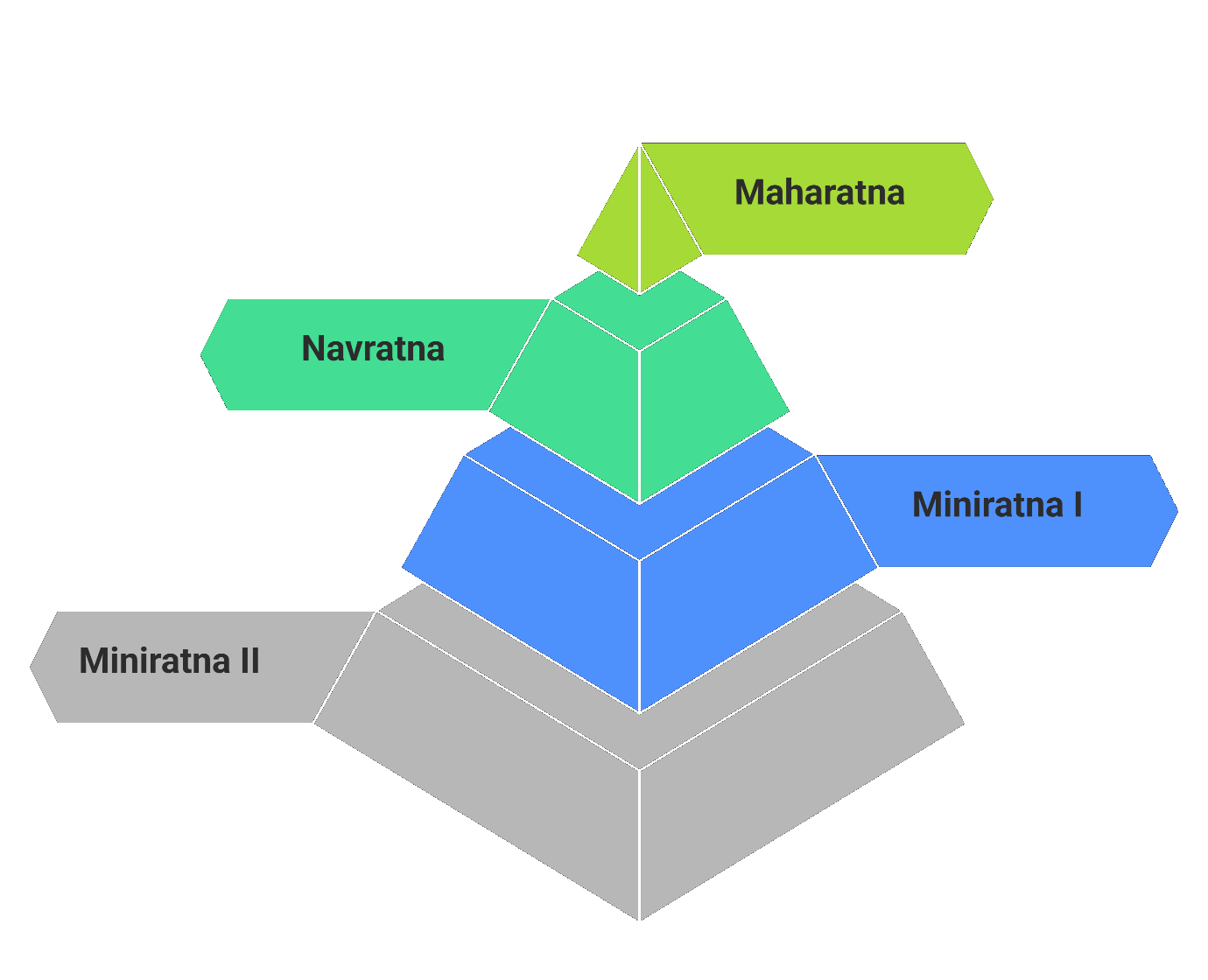
Classification of PSUs
- Maharatna PSUs
- Navratna PSUs
- Miniratna Category- I
- Miniratna Category- II
Maharatna PSUs:
Maharatna is a status awarded to leading public sector enterprises, granting them the authority to make foreign investments of up to Rs 5,000 crores without requiring government approval. To qualify as Maharatna, a company must achieve an annual net profit of over Rs 5,000 crores, a net worth of Rs 15,000 crores, and a turnover of Rs 25,000 crores over the past three consecutive years. Currently, the CPSEs with Maharatna status include: BHEL, BPCL, CIL, GAIL, HPCL, IOCL, NTPC, ONGC, PFC, RECL, OIL INDIA LIMITED, PGCIL, SAIL, and HAL.
Navratna PSUs:
Navratna status is awarded to companies by the Department of Public Enterprises, Government of India. To qualify as a Navratna, a company must score at least 60 out of 100. The score is based on six parameters, including net profit to net worth, total manpower cost to total production or service cost, PBDIT (Profit before depreciation, interest, and taxes) to capital employed, PBDIT to turnover, EPS (Earnings per Share), and inter-sectoral performance. Additionally, a company must first be a Miniratna and have four independent directors on its board before it can be designated as a Navratna. The Navratna status grants privileges to enhance financial and operational autonomy and allow companies to invest up to Rs 1000 crores or 15% of its net worth in a single project without seeking government approval. Annually, these companies can spend up to 30% of their net worth, not exceeding Rs 1000 crores. They also have the freedom to enter joint ventures, form alliances, and establish subsidiaries abroad.
Miniratna PSUs:
Talking about Miniratna, the Government of India started giving "Miniratna" status to some public sector companies in 1997. Its purpose was to give more financial power to those companies that were earning good profits. Miniratna companies are divided into two categories - Category I and Category II. Let's understand these two categories:
- Category I: Category I includes those companies that have earned a pre-tax profit of at least Rs 3 crores (30 million) every year for three consecutive years and whose net worth is also positive.
- Category II: Category II includes those companies that are continuously earning profit and whose assets are also positive, but their profit is slightly less than Category I companies.
As we discussed earlier, India’s Public Sector Undertakings (PSUs) are classified into different categories based on their financial performance, operational efficiency, and strategic importance. These classifications help in identifying their autonomy and influence in the economy. As of now, there are 14 Maharatna, 25 Navratna, 51 Miniratna Category-I, and 11 Miniratna Category-II companies. These companies are playing a unique role in driving the growth and development of the country. All these are shown through the table below:
| Status | Number Of PSUs |
|---|---|
| Maharatna | 14 |
| Navratna | 25 |
| Miniratna Category- I | 51 |
| Miniratna Category- II | 11 |
PSUs Salary Structure
Let's move further and explore the most exciting part, the salary in PSUs? So far, you have known what a PSU is and how many PSUs there are across the country, as well as how to get entry into this sector. Now let's know what is the salary of a PSU job? Known for its stability and attractive perks, PSU jobs offer competitive salary packages as well as job security, as well as benefits like perks and pension, making them a great career choice for many ambitious professionals across the country.
| Organization | Status | Salary Structure |
| Oil & Natural Gas Corporation Limited (ONGC) | Maharatna | Rs. 60,000-1,80,000 |
| Indian Oil Corporation Limited (IOCL) | Maharatna | Rs. 60,000-1,80,000 |
| National Thermal Power Corporation Limited (NTPC) | Maharatna | Rs. 60,000-1,80,000 |
| Coal India Limited (CIL) | Maharatna | Rs. 60,000-1,80,000 |
| Steel Authority of India (SAIL) | Maharatna | Rs. 60,000-1,80,000 |
| Bharat Petroleum Corporation Limited (BPCL) | Maharatna | Rs. 60,000-1,80,000 |
| Gas Authority of India Limited (GAIL) | Maharatna | Rs. 60,000-1,80,000 |
| Neyveli Lignite Corporation Limited(NLC) | Navratna | Rs.20600-46500 |
| Hindustan Petroleum Corporation Limited (HPCL) | Maharatna | Rs. 60,000-1,80,000 |
| Oil India Limited (OIL) | Maharatna | Rs. 60,000-1,80,000 |
| Power Grid Corporation of India Limited (PGCIL) | Maharatna | Rs. 60,000-1,80,000 |
| Hindustan Aeronautics Limited (HAL) | Maharatna | Rs.16,400-40,500 |
| National Mineral Development Corporation Limited (NMDC) | Navratna | Rs. 40000-140000 |
| Power Finance Corporation Limited | Maharatna | Rs. 40,000-1,40,000 |
| National Aluminum Company Limited (NALCO) | Navratna | Rs. 60,000-1,80,000 |
| Mazagaon Docks Limited (MDL) | Navratna | Rs. 40,000-1,40,000 |
| Airport Authority Of India Limited (AAI) | Mini-Ratna | Manager: Rs.60,000-1,80,000 Junior Executive: Rs. 40,000-1,40,000 |
| Mineral Exploration Corporation Limited | Mini-Ratna | Rs. 60,000-1,80,000 |
PSUs Age Criteria
When it comes to applying for jobs in public sector undertakings (PSUs), age criteria play a vital role. Each PSU prescribes specific age limits based on the position, category of the candidate, and level of responsibility. Understanding these age requirements is important to plan your career path and ensure you meet the eligibility criteria before applying. Let us understand the age limits in the PSU sector:
| Organization | Age Criteria | |||
|---|---|---|---|---|
| PSU Name | GEN | OBC | SC/ST | PH |
| Bridge & Roof co. (I) Ltd | 24 years | 24-27 years | 29 years | 29 years-General, 32 years-OBC, 34 years- SC/ST |
| BHEL | 27 years | 27-30 years | 32 years | 32 years-General, 35 years-OBC, 37 years- SC/ST |
| ONGC | 30 years | 30-33 years | 35 years | 35 years-General, 38 years-OBC, 40 years- SC/ST |
| NTPC | 27 years | 27-30 years | 32 years | 32 years-General, 35 years-OBC, 37 years-SC/ST |
| SAIL | 30 years | 30-33 years | 35 years | 35 years-General, 38 years-OBC, 40 years- SC/ST |
| IOCL | 26 years | 26-29 years | 31 years | 31 years-General, 34 years-OBC, 36 years- SC/ST |
| ISRO | 28 years | 28-31 years | 33 years | 33 years-General, 36 years-OBC, 38 years- SC/ST |
| PGCIL | 28 years | 28-31 years | 33 years | 33 years-General, 36 years-OBC, 38 years- SC/ST |
| HAL | 28 years | 28-31 years | 33 years | 33 years-General, 36 years-OBC, 38 years- SC/ST |
| NALCO | 30 years | 30-33 years | 35 years | 33 years-General, 36 years-OBC, 38 years- SC/ST |
| GAIL | 28 years | 28-31 years | 33 years | 33 years-General, 36 years-OBC, 38 years- SC/ST |
| DRDO | 28 years | 28-31 years | 33 years | 33 years-General, 36 years-OBC, 38 years- SC/ST |
| DMRC | 28 years | 28-31 years | 33 years | 33 years-General, 36 years-OBC, 38 years- SC/ST |
| BPCL | 28 years | 28-31 years | 33 years | 33 years-General, 36 years-OBC, 38 years- SC/ST |
| MTNL | 30 years | 30-33 years | 35 years | 35 years-General, 38 years-OBC, 40 years- SC/ST |
| HPCL | 25 years | 25-28 years | 30 years | 30 years-General, 33 years-OBC, 35 years- SC/ST |
| BEL | 25 years | 25-28 years | 30 years | 30 years-General, 33 years-OBC, 35 years- SC/ST |
| BARC | 28 years | 28-31 years | 33 years | 33 years-General, 36 years-OBC, 38 years- SC/ST |
| Indian Railways | 22 to 35 years | + 3 years | + 5 years | + 5 years-General, +8 years-OBC, +10 years- SC/ST |
| VIZAG STEEL | 25 years | 25-28 years | 30 years | 30 years-General, 33 years-OBC, 35 years- SC/ST |
| NHPC | 30 years | 30-33 years | 35 years | 35 years-General, 38 years-OBC, 40 years- SC/ST |
| BSNL | 30 years | 30-33 years | 35 years | 35 years-General, 38 years-OBC, 40 years- SC/ST |
| PRASAR BHARATI | 27 years | 27-30 years | 32 years | 32 years-General, 35 years-OBC, 37 years-SC/ST |
PSUs Percentage Criteria
When applying for a job in a PSU, several criteria must be met, with your academic performance being a key factor. Most PSUs require a minimum percentage in qualifying exams like B.E./B.Tech or equivalent degree. This ensures that candidates meet a certain academic standard. While cut-off percentages vary across organisations and categories, meeting the percentage criteria is a must for eligibility and shortlisting.
| Organization | Streams Applicable | Percentage | |||
|---|---|---|---|---|---|
| GEN | OBC | SC/ST | PH | ||
| BHEL | EC, EE, ME, MT | 60 | 60 | 60 | 60 |
| ONGC | ECE, EE, ME, CE, CS, IN, CH, | 60 | 60 | 60 | 60 |
| NTPC | EC, EE, ME, CS, IN | 65 | 65 | 55 | 55 |
| SAIL | EC ,EE, ME, CS, IN, CH, Metallurgy, Ceramics | 65 | 65 | 55 | 55 |
| IOCL | EC, EE, ME, CE, CS, IN | 65 | 65 | 55 | 55 |
| ISRO | EC, EE, ME, CS | 65 | 65 | 65 | 65 |
| PGCIL | EC, EE, ME, Industrial, Production CS, IN , EE, ME, CS, IT, C&I, | 65 | 65 | Pass | Pass |
| NALCO | EE, ME, CS, IT, C&I, Civil, Chemical, Metallurgy, Mining, | 65 | 65 | 55 | 55 |
| GAIL | EC, EE, ME, CS, IN, CH | 65 | 65 | 60 | 60 |
| DRDO | EC, ME, EE, CS, CH | 60 | 60 | 55 | 55 |
| DMRC | EC, EE, ME, CE | 60 | 60 | 55 | 55 |
| BPCL | ME, CS, IN | 60 | 60 | 55 | 55 |
| MTNL | EC, EE, CS, IT | 60 | 60 | 55 | 55 |
| HPCL | EC, EE, ME, CE, IN, CH | 60 | 60 | 50 | 50 |
| BEL | EC, EE, ME, CE, CS, CH, Telecommunication | 60 | 60 | Pass | Pass |
| Indian Railways | EC, EE, ME, CE | Pass | Pass | Pass | Pass |
| ECIL | EC, EE, ME, CE, CS, E&I | 65 | 65 | 55 | 55 |
| VIZAG STEEL | EC, EE, ME, CE, CH, IN, Ceramics, | 60 | 60 | 50 | 50 |
| NHPC | EE, ME, CE | 60 | 60 | 50 | 50 |
| SJVNL | EC, EE, ME, Civil, IT | 55 | 50 | 50 | 50 |
| BSNL | Telecommunication, EC, Radio, CS, EE, IT, CE | 60 | 60 | 55 | 55 |
| BHARATI PRASAR | EC, EE, IT | Pass | Pass | Pass | Pass |
PSUs Path with HARI CLASSES
No matter where you are, where you start, your PSU dream deserves the best companion, and then HARI CLASSES comes in. With expert guidance, structured learning, and unwavering support, HARI CLASSES walks with you—every step, every challenge, every victory. Let’s turn your preparation into success, the HARI CLASSES way!


